Choosing the right real estate CRM in the UAE is about more than managing contacts.
A brokerage may need to manage leads from multiple sources, distribute inquiries across agents, control listings, work with property portals, manage off-plan projects, track transactions and commissions, and understand team performance all while keeping hundreds or thousands of client interactions organized.
So, what should you actually look for when choosing a real estate CRM in the UAE?
What Is the Best Real Estate CRM for UAE Brokerages?
The best real estate CRM for a UAE brokerage is one that fits the company's actual operating model.
For most brokerages, this means looking for a platform that can centralize:
Lead capture and management
Automatic lead distribution and rotation
Property listings
UAE property portal workflows
Owners and client databases
Off-plan projects
Transactions and documents
Agent commissions
Tasks and follow-ups
Approval workflows
Agent and team KPIs
Management reporting
Mobile access
The right choice will also depend on the size of the brokerage, its sales model, the markets it operates in, and how much customization it requires.
A five-agent boutique agency and a brokerage with 150 agents may need very different CRM configurations even if they operate in the same market.
What Is a Real Estate CRM?
A real estate CRM is a platform used to manage relationships and activities across the property sales or rental journey.
Unlike a basic contact-management system, a real estate CRM may connect a client inquiry with the property they are interested in, the assigned agent, follow-up activities, viewings, listings, transactions and ultimately the resulting deal.
For management, this creates one centralized view of what is happening across the brokerage.
Instead of information being divided between spreadsheets, personal phones, WhatsApp conversations, property portals and separate systems, a CRM creates a structured environment for the team to work from.
Why UAE Real Estate Has Different CRM Requirements
Real estate brokerages in the UAE can have operational requirements that are different from those of many traditional sales organizations.
An agency may simultaneously manage:
Off-plan and secondary-market properties
Sales and rental inquiries
Buyers, tenants and property owners
Multiple agent teams
Property portal inquiries
Developer projects
Listing inventory
Internal approval processes
Agent and referral commission structures
Multiple branches or departments
This is why the distinction between a general-purpose CRM and a real estate-specific CRM is important.
A general CRM can offer powerful sales, marketing and automation capabilities. However, a brokerage may need additional configuration or integrations to accommodate property-specific processes.
A specialized real estate CRM, on the other hand, is designed around these workflows from the beginning.
10 Features to Look for in a UAE Real Estate CRM
1. Lead Management
Lead management should go far beyond storing a name and phone number.
A brokerage should be able to see where each inquiry originated, who received it, what actions have been taken, when the next follow-up is due and where the lead currently sits in the sales pipeline.
This becomes especially important when a company is receiving inquiries from several channels simultaneously.
2. Automatic Lead Distribution
As a brokerage grows, manually assigning every new inquiry becomes difficult to control.
A CRM should allow companies to create structured lead-assignment rules.
Depending on the system, this can include round-robin distribution, agent availability, team structures, working hours or other assignment conditions.
An important feature to evaluate is what happens when an assigned agent does not act on a new lead.
Good lead-management systems should give management visibility over this process rather than allowing an inquiry to disappear unnoticed.
3. Property Portal Integration
Property portals play an important role in the UAE real estate market.
When evaluating CRM software, brokerages should understand how the system works with the portals they use.
Questions to ask include:
Can portal inquiries enter the CRM automatically?
Can the original lead source be identified?
Can leads be assigned automatically?
Can listings be published or synchronized?
Can managers measure results by source?
How are listing updates handled?
The objective is to reduce duplicate work while maintaining visibility over both inquiries and inventory.
4. Listings Management
Listings are one of the core assets of a real estate brokerage.
A CRM should provide a centralized place to create, organize, update and manage property inventory.
For UAE brokerages, useful functionality can include sales and rental listings, media and document storage, property information, map views, portal publishing, website publishing and internal inventory sharing.
Centralizing this information also helps reduce the problem of different agents working from different versions of the same property information.
5. Off-Plan Project Management
Off-plan is a significant part of the UAE real estate ecosystem.
Brokerages working with developers should therefore consider whether a CRM can organize developer and project information alongside leads and transactions.
Agents should be able to find relevant project information quickly instead of relying entirely on scattered PDFs, WhatsApp groups or individual spreadsheets.
6. Transaction Management
Closing the deal should not mean leaving the CRM.
A comprehensive real estate platform should allow teams to track transactions after the lead and viewing stages.
Depending on the brokerage, this may include:
Off-plan sales
Secondary-market sales
Rentals
Renewals
Transaction documents
Deal stages
Tasks and deadlines
Internal approvals
Connecting the transaction to the original lead, listing and agent gives management a clearer picture of the full sales cycle.
7. Commission Management
Commission structures can become complex as a brokerage grows.
A deal may involve an agent, another internal team member, an external broker or a referral partner.
CRM software designed for brokerage operations can help structure these commission splits and provide visibility over received, receivable and pending amounts.
This reduces dependence on separate spreadsheets and makes transaction performance easier to analyze.
8. Workflows, Permissions and Approvals
Not every person in a brokerage should have the same access or authority.
Managers may need to approve transactions. Admin teams may control listings. Team leaders may need visibility over their agents without seeing information belonging to another department.
A CRM should therefore support roles, permissions, team structures and approval workflows that reflect how the company actually operates.
9. Reporting and KPIs
A CRM contains valuable information only if management can understand it.
Useful reporting should help answer questions such as:
How many leads are we receiving?
Which sources generate those leads?
How quickly are agents responding?
How many calls and viewings are being completed?
Which leads are progressing?
Which agents or teams are converting?
Which sources contribute to completed transactions?
What commissions have been generated?
The objective should not simply be to collect more data.
It should be to make better operational decisions from that data.
10. Mobile Access
Real estate agents spend a significant amount of time outside the office.
Mobile access allows agents to receive new inquiries, check client information, update activities, manage tasks and access property information while working in the field.
When evaluating a CRM, companies should test the mobile experience as seriously as the desktop experience.
Generic CRM vs Real Estate CRM: What's the Difference?
General-purpose CRM platforms can be a strong choice for organizations that require broad sales and marketing customization.
They can offer extensive automation, integrations and flexible pipeline management.
The trade-off for a real estate brokerage is that property-specific workflows may require additional setup.
A specialized real estate CRM is designed around the relationship between:
Lead → Agent → Property → Viewing → Transaction → Commission
That can reduce the amount of customization required to establish the brokerage's core processes.
Neither approach is automatically right for every company.
The better question is:
How much of our existing real estate workflow does the CRM support without requiring us to build it ourselves?
How Should You Compare Real Estate CRM Systems?
When comparing systems, don't start with the number of features.
Start with your workflow.
Create a real transaction journey and ask each CRM provider to demonstrate it.
For example:
A Property Finder inquiry arrives → the lead enters the CRM → it is automatically assigned → the agent receives a notification → follow-ups are recorded → a viewing is scheduled → the client proceeds → a transaction is created → management approves it → commission is recorded → management can measure the complete journey.
This type of demonstration tells you far more than a long feature checklist.
What CRM Does a Small Real Estate Agency Need?
A smaller brokerage may prioritize:
Easy implementation
Lead management
Listings
Portal connectivity
Follow-up reminders
Simple reporting
Mobile access
The objective should be adoption.
A sophisticated system provides little value if agents don't use it consistently.
What Should a Growing Brokerage Look For?
As teams grow, requirements usually become more operational.
A growing brokerage may need:
Automated lead rotation
Multiple teams
Roles and permissions
Approval workflows
Custom pipelines
Commission structures
Agent KPIs
Source analytics
Database management
Stronger management reporting
At this stage, CRM becomes less about maintaining contacts and more about creating a consistent operating structure.
What Should a Large Brokerage Look For?
Larger organizations should evaluate whether the platform can support complexity without becoming difficult to manage.
Important considerations can include:
Multiple branches
Department structures
Large agent teams
Advanced permissions
High lead volumes
Custom workflows
Management visibility
Detailed KPI reporting
Database control
Integrations
Scalability
The CRM should provide individual agents with simplicity while giving management deeper operational control.
Questions to Ask During a CRM Demo
Before choosing a platform, ask the provider to show you not just tell you how the system handles your everyday operations.
Useful questions include:
How are Property Finder and Bayut leads captured?
Can leads be automatically distributed?
What happens when an agent doesn't respond?
How are listings created and updated?
Can listings be published to the portals we use?
How are off-plan projects managed?
Can we customize our sales pipelines?
How are transactions and documents managed?
How are agent and referral commissions handled?
Can management see agent response and conversion performance?
Can permissions be configured by team or role?
What does onboarding involve?
What support is available after implementation?
Can the platform scale as our team grows?
How easily can our existing database be migrated?
The answers should reflect your actual operating model rather than a generic software demonstration.
Where Does Pixxi CRM Fit?
Pixxi is a real estate CRM built specifically for brokerages operating in the UAE.
Rather than using a generic sales CRM and adapting it to property operations, Pixxi connects the major parts of a brokerage within one platform.
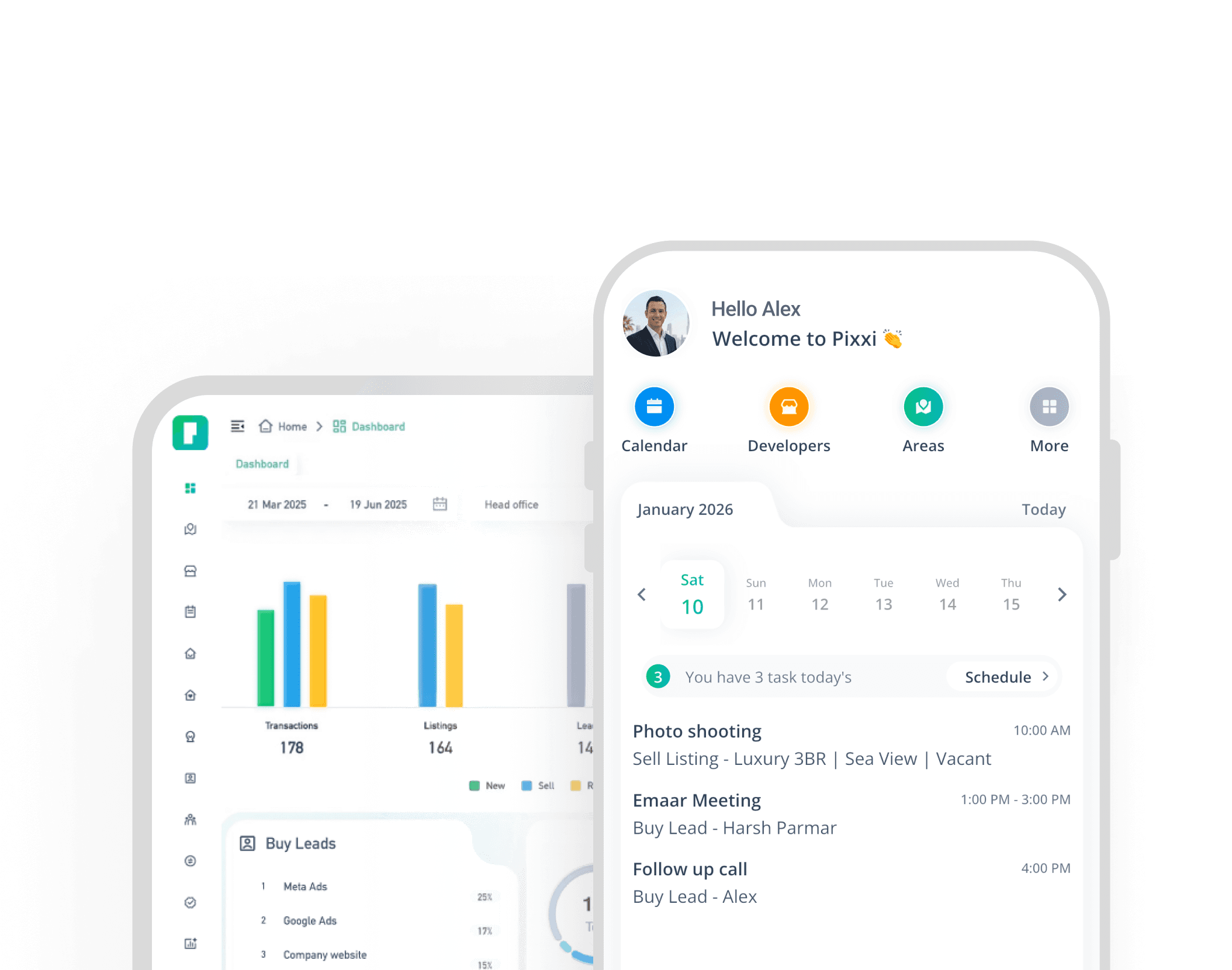
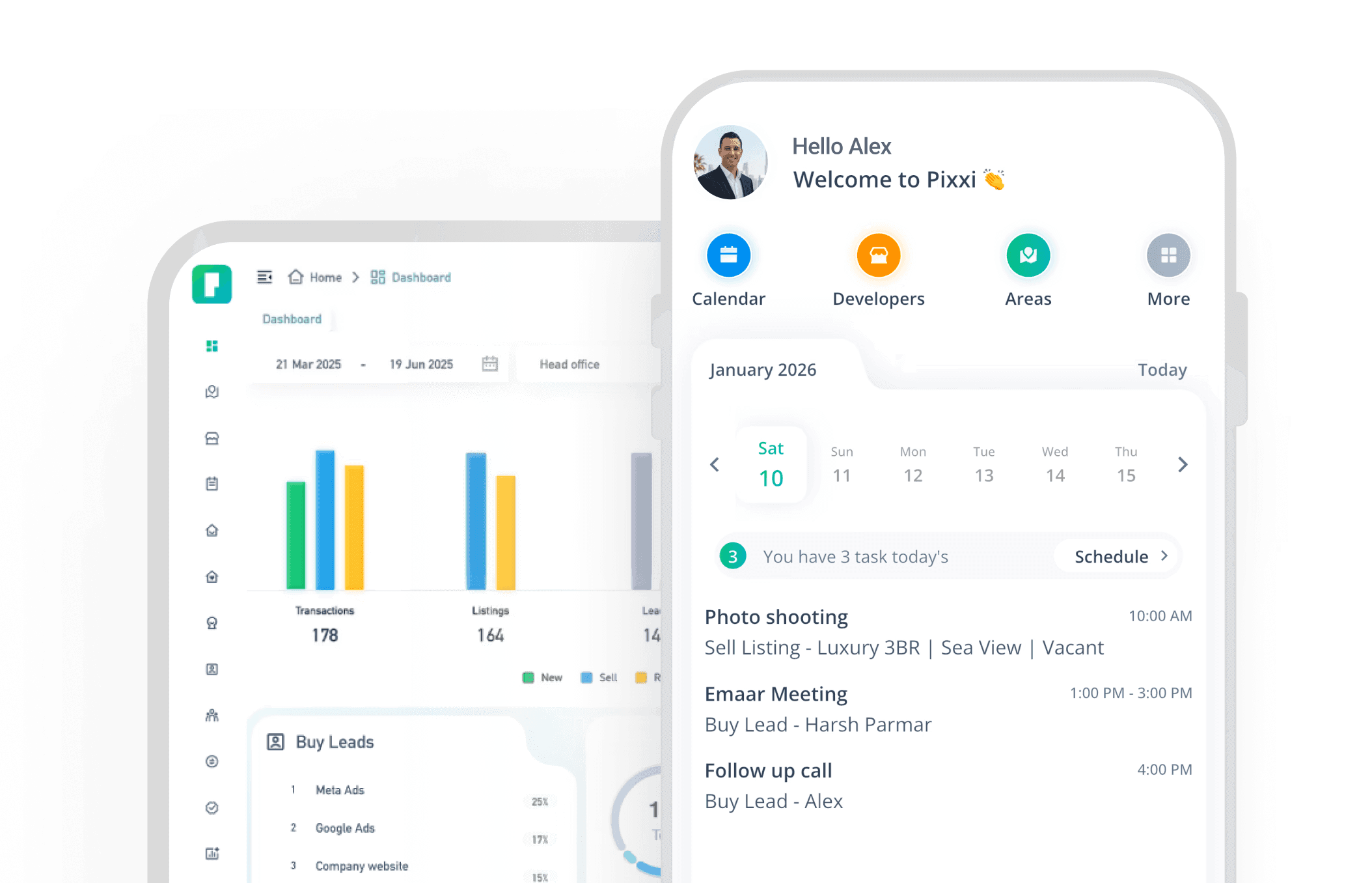
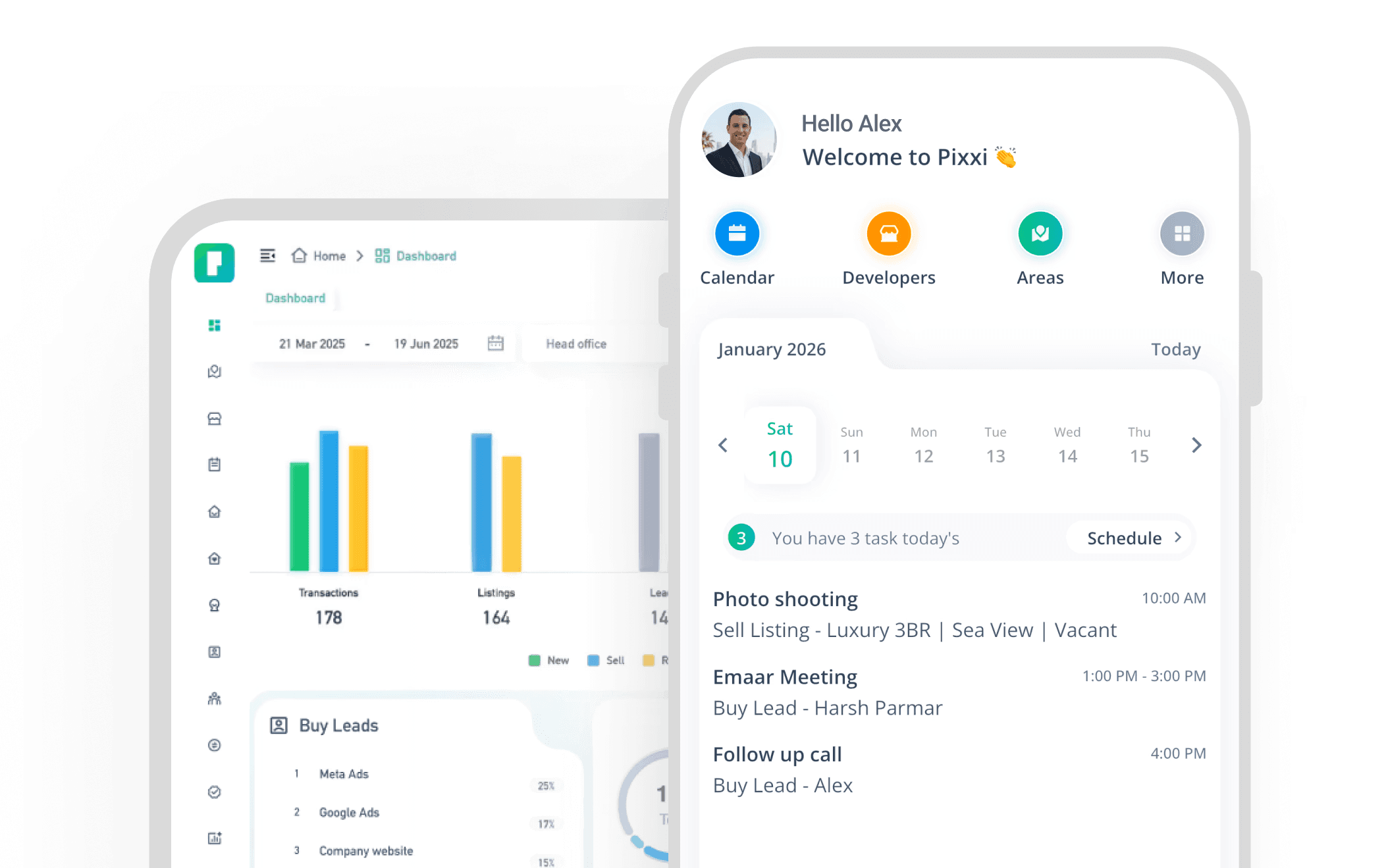
Pixxi currently includes lead management, automatic lead distribution and rotation, listings, owners, off-plan projects, transactions and commissions, database management, workflows and approvals, KPI insights, map-based inventory views, custom fields and mobile access.
For lead management, inquiries can be centralized from sources including Property Finder, Bayut, websites and advertising campaigns. Brokerages can then use assignment rules and lead rotation to distribute inquiries and track agent activity.
Listings can be managed centrally and connected with major UAE property portals, while transaction functionality supports off-plan sales, secondary-market sales, rentals and renewals.
Management can also monitor activities including leads, listings, calls, viewings and transactions and analyze performance by agent, team, branch, source or time period.
The objective is to connect the journey from initial inquiry through to transaction and commission rather than managing each stage in a separate tool.
How to Choose the Right CRM for Your Brokerage
There is no single CRM configuration that is right for every real estate company.
Before choosing a platform, consider five questions:
Does it fit our market?
Make sure the platform supports the property workflows and channels your brokerage actually uses.
Will our agents use it?
Ease of use and mobile accessibility directly affect adoption.
Can management see what's happening?
A CRM should create visibility, not simply another database.
Can it support our processes?
Lead assignment, approvals, listings, transactions and commissions should reflect how your company operates.
Can it grow with us?
Consider what happens when your brokerage doubles its number of agents, leads, listings or branches.
The best CRM is ultimately the one that becomes part of the company's daily operation rather than another system employees are required to update.
Final Thoughts
Choosing a real estate CRM should not start with asking which platform has the longest feature list.
Start by mapping how your brokerage actually works.
Where do your leads come from? How are they distributed? How are listings managed? Who approves transactions? How are commissions calculated? What information does management need every day?
Then ask each CRM provider to demonstrate that workflow from beginning to end.
A CRM should ultimately create three things for a brokerage:
Structure. Visibility. Control.
Pixxi CRM was built specifically around these requirements for UAE real estate brokerages.
If you're evaluating a new CRM, book a Pixxi demo and bring your existing workflow with you. Our team can show you how it can be structured inside Pixxi.
FAQ
What is a real estate CRM?
A real estate CRM is software that helps property companies manage leads, clients, listings, activities, transactions and other parts of the sales or rental process in one centralized system.
What should a real estate CRM include in the UAE?
UAE brokerages should consider lead management, property portal workflows, listings, off-plan projects, transactions, commissions, agent performance, permissions, approvals, reporting and mobile accessibility.
Can a CRM manage Property Finder and Bayut leads?
Real estate CRMs with the appropriate integrations can automatically capture inquiries from property portals and record the source inside the CRM. The exact capabilities depend on the CRM and integration available.
What is lead rotation in real estate?
Lead rotation is the automated distribution of new inquiries between eligible agents according to predefined rules. It can help brokerages distribute inquiries consistently and reduce manual assignment.
Can a CRM track real estate agent commissions?
Some real estate-specific CRM platforms include transaction and commission management, allowing brokerages to record commission structures, splits, receivable amounts and received commissions.
Is a generic CRM suitable for a UAE real estate company?
It can be. Generic CRMs provide extensive sales and marketing capabilities, but a UAE brokerage should evaluate how much additional configuration is required for listings, portals, off-plan projects, commissions and other property-specific workflows.
Is Pixxi designed specifically for UAE real estate?
Yes. Pixxi is built around UAE real estate brokerage operations, including leads, listings, portal workflows, off-plan projects, transactions, commissions, workflows and performance reporting.
Experience the fastest, most complete real estate CRM on mobile
With Pixxi, your entire business travels with you real-time updates, instant lead access, and seamless team communication.