Choosing a real estate CRM in Dubai is no longer simply about finding somewhere to store leads.
UAE brokerages today manage leads from multiple channels, hundreds or thousands of listings, property portal integrations, growing agent teams, transactions, commissions, marketing campaigns and management reporting.
The right CRM should bring these operations together.
The wrong one can simply become another system your agents are required to update.
So, what should a UAE real estate brokerage actually look for when choosing a CRM?
Start With Real Estate, Not CRM
One of the first decisions is whether to use a general-purpose CRM or a platform designed specifically around real estate operations.
A traditional CRM may be excellent at managing contacts and sales pipelines, but real estate brokerages have requirements that go far beyond a standard sales process.
Agents work with:
Buyers and tenants
Owners and landlords
Properties and listings
Property portals
Viewings
Deals
Commissions
Agent splits
Off-plan projects
Marketing-generated inquiries
These relationships need to work together.
A CRM designed around real estate can reduce the amount of customization and manual work required to make a generic system fit a brokerage.
1. Check How Leads Enter the CRM
Start with one simple question:
How will our leads actually get into the system?
A brokerage may generate inquiries through property portals, websites, advertising platforms, referrals and other channels.
If employees still need to manually copy information between platforms, the CRM is not fully solving the problem.
Look for a system that can centralize inquiries and maintain their source information.
This gives agents a clearer workflow and allows management to understand where opportunities are actually coming from.
2. Look Beyond Lead Management
Lead management is important, but it is only one part of brokerage operations.
A strong real estate CRM in the UAE should also help manage listings, agents, deals and performance.
Think about the full journey:
Lead → Agent → Listing → Viewing → Negotiation → Transaction → Commission
If each stage requires a different system, spreadsheet or manual process, information becomes fragmented.
The goal should be to create one connected operational environment.
3. Property Portal Integration Is Essential
Property portals play a major role in the UAE real estate market.
For many brokerages, platforms such as Property Finder, Bayut and dubizzle are central to listing exposure and lead generation.
Your CRM should therefore fit naturally into this ecosystem.
Before choosing a system, understand how it handles listing publication, portal-generated inquiries and the operational processes surrounding your property inventory.
A CRM built for another market may offer excellent generic features while missing workflows that UAE agents use every day.
4. Understand How Listings Are Managed
Listings are one of the most valuable operational assets inside a brokerage.
Yet many companies still manage inventory through a combination of spreadsheets, messaging groups and individual agent records.
A real estate CRM should give teams a structured way to manage property information while connecting listings to agents, owners and potential clients.
This creates a much clearer picture of both supply and demand inside the business.
5. Ask How Leads and Listings Work Together
This is an important distinction.
Having a lead database and a listing database is useful.
Connecting them is much more powerful.
Agents should be able to work with client requirements and identify suitable inventory without constantly switching between disconnected tools.
For a brokerage with a large database, structured lead and listing matching can help uncover opportunities that might otherwise remain hidden.
6. Evaluate Lead Distribution and Agent Accountability
When a new inquiry arrives, what happens next?
Who receives it?
How quickly?
What happens if it is not contacted?
How does management know?
These questions become increasingly important as a brokerage grows.
A good CRM should support structured lead assignment and rotation while maintaining visibility over ownership and follow-up.
The objective is not to create unnecessary monitoring.
It is to make sure every valuable inquiry has a clear owner and next action.
7. Make Sure Agents Can Actually Use It
A CRM can have hundreds of features and still fail if agents avoid using it.
This is particularly important in real estate because agents spend much of their working day away from a desk.
They are attending viewings, meeting clients, visiting projects and speaking with owners.
Mobile accessibility therefore matters.
Agents should be able to access important information and take action while working outside the office.
A CRM should support the way agents already work not force their entire working day behind a desktop.
8. Look at Transaction and Commission Management
Closing a deal is not the end of the operational process.
Brokerages still need to manage transaction information, approvals, commissions, agent splits and financial visibility.
When these processes are handled manually, management can spend significant time checking spreadsheets and reconciling information between departments.
Connecting transactions and commissions to the wider CRM creates a more complete picture of brokerage performance.
9. Reporting Should Answer Business Questions
Dashboards are useful only when they help management make decisions.
Before selecting a CRM, consider what you actually want to know.
For example:
Which lead sources are performing?
Which agents are converting opportunities?
How many active deals are currently in the pipeline?
How is the listing inventory performing?
Where are leads being lost?
What is happening with transactions and commissions?
A CRM should turn operational activity into usable business insight.
10. Consider Whether the CRM Can Scale With You
A system that works for five agents may not necessarily work for fifty.
Before making a decision, consider where the brokerage is going not only where it is today.
Think about:
User growth
Larger databases
More listings
Multiple teams
Approval structures
Increasing lead volumes
More complex reporting
Additional integrations
Changing your core CRM after significant growth can be disruptive.
Choosing infrastructure that can grow with the company is therefore an important long-term decision.
11. Support and Implementation Matter
Technology alone does not create successful CRM adoption.
Implementation, onboarding and ongoing support can make a major difference.
Brokerages should understand what happens after the contract is signed.
How will the system be configured?
How will existing data be migrated?
How will administrators be trained?
How will agents learn the system?
Who supports the team when questions arise?
A powerful CRM without proper implementation can quickly become an underused one.
A Simple Test Before Choosing Your CRM
Before committing to a platform, ask whether it gives management clear visibility across these five areas:
Leads. Agents. Listings. Deals. Performance.
If important parts of the brokerage still need to be managed outside the system, understand why.
The best solution is not necessarily the CRM with the longest feature list.
It is the one that fits how your brokerage actually operates.
Why UAE Brokerages Choose Pixxi CRM
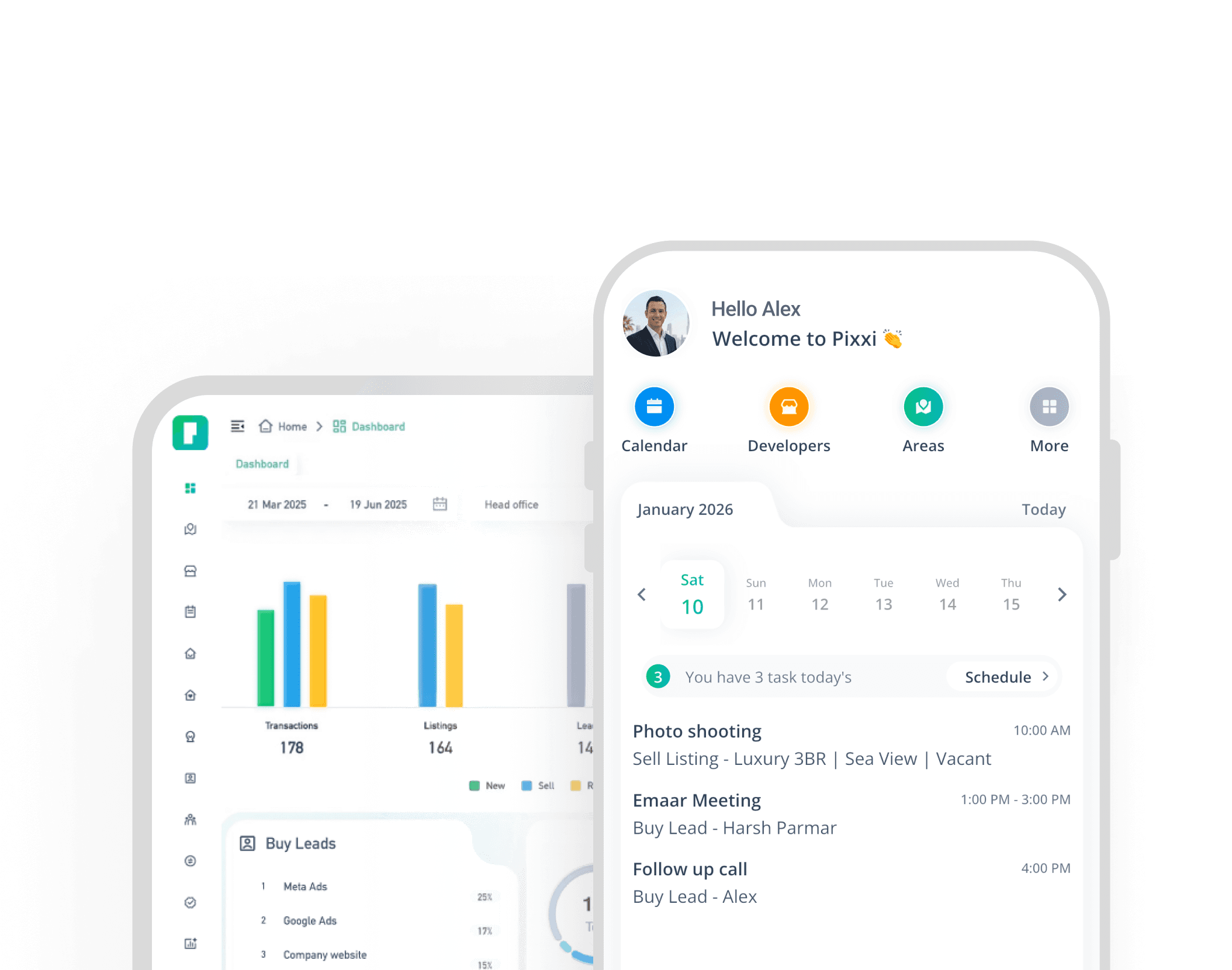
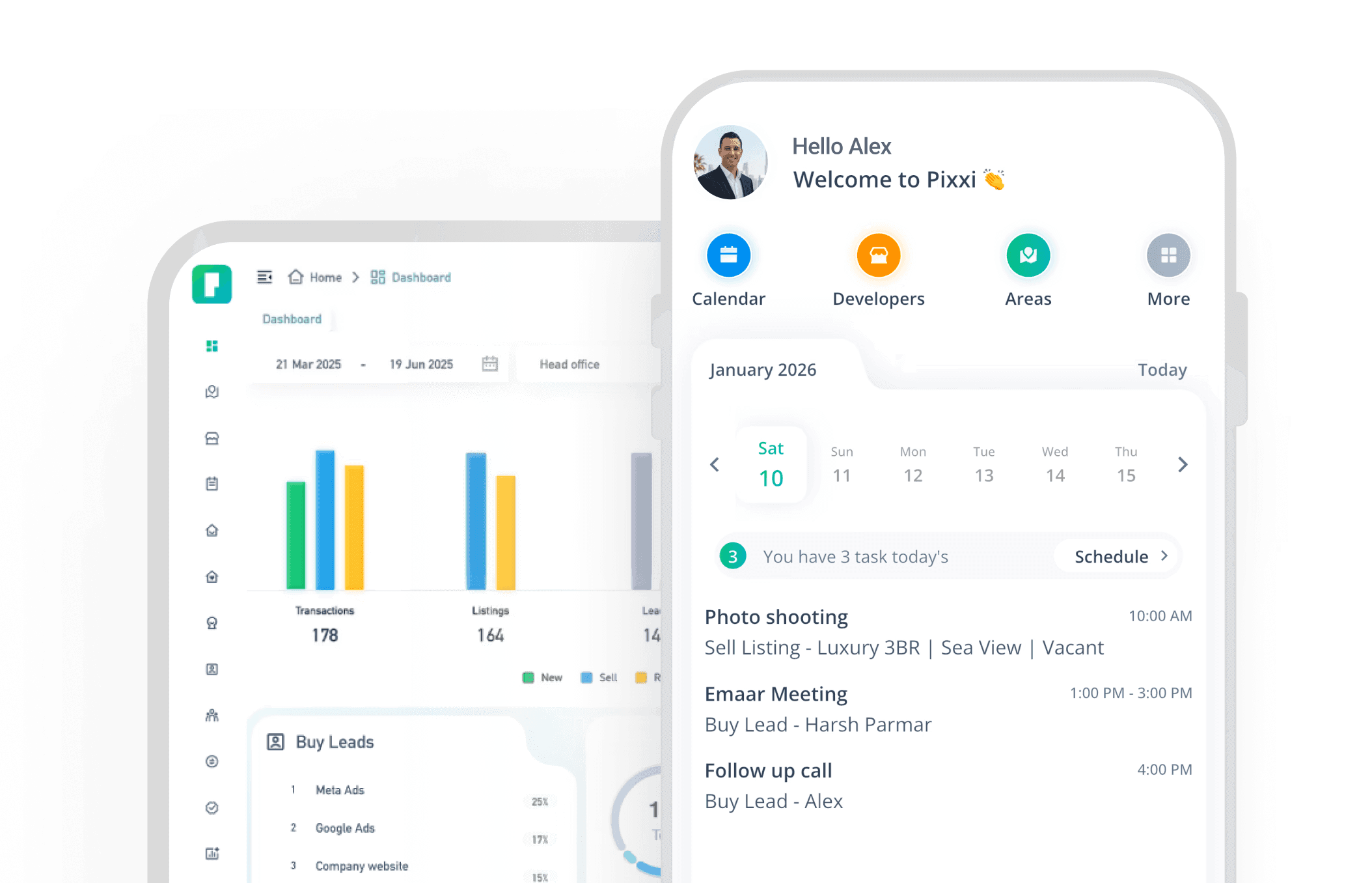
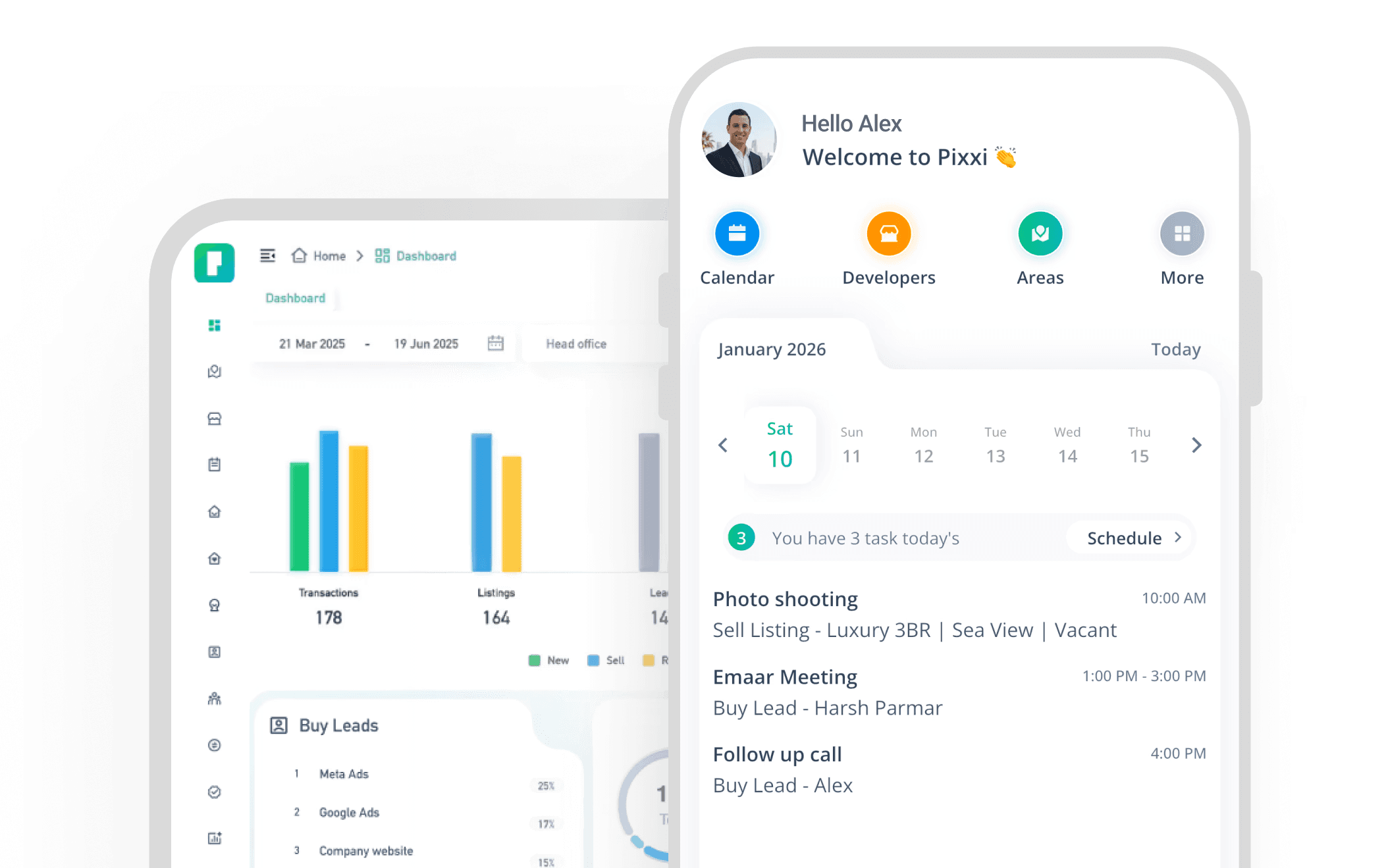
Pixxi CRM is built specifically around real estate brokerage operations, with workflows designed for the UAE market.
It brings leads, agents, listings, transactions, commissions and performance into one connected ecosystem.
From portal integrations and structured lead distribution to listing management, lead and listing matching, reporting and mobile access, Pixxi helps brokerages replace fragmented processes with greater operational visibility.
The result is not simply another CRM.
It is a structured system behind the brokerage.
Choosing a CRM Is an Operational Decision
The CRM you choose affects more than your sales team.
It influences how leads are distributed, how agents work, how listings are managed, how deals are tracked and how management understands performance.
That makes CRM selection an operational decision not simply a software purchase.
The right real estate CRM should give your brokerage structure today and the ability to scale tomorrow.
Looking for a real estate CRM built around the way UAE brokerages operate? Explore Pixxi CRM and see how your entire operation can work from one connected system.
Experience the fastest, most complete real estate CRM on mobile
With Pixxi, your entire business travels with you real-time updates, instant lead access, and seamless team communication.