Growth is exciting.
More agents. More listings. More leads. More transactions.
But for a real estate brokerage, growth also creates complexity.
The processes that worked perfectly with 10 agents can start breaking at 30. What worked at 30 may become impossible at 100.
Suddenly, managers are chasing updates. Leads are being handled inconsistently. Listings are scattered. Commission calculations become complicated. And leadership struggles to understand what is actually happening across the business.
The challenge is not simply how to grow a real estate brokerage.
It is how to grow without losing control.
More Agents Don't Automatically Mean More Growth
Hiring is often one of the first responses to growth.
More agents should mean more capacity, more clients and ultimately more transactions.
But increasing headcount without strengthening the systems behind the brokerage can create the opposite effect.
Every additional agent creates more:
Leads to distribute
Listings to manage
Activities to track
Data to maintain
Deals to process
Commissions to calculate
Performance to measure
Without structure, headcount grows faster than operational control.
The brokerage becomes bigger but not necessarily more efficient.
The Processes That Got You Here May Not Get You Further
Many successful brokerages begin with relatively simple processes.
A spreadsheet tracks leads.
WhatsApp keeps everyone connected.
Agents manage their own clients.
Listings are shared between teams manually.
Managers know most deals personally.
At a smaller scale, this can work.
But growth exposes the limitations.
When hundreds of inquiries, listings and activities are moving through the company, management can no longer depend on individual memory or constant communication to understand the business.
Processes need to become systems.
Centralize Your Brokerage Data
One of the foundations of scalable operations is having a central source of information.
When leads live in one system, listings somewhere else, commissions in spreadsheets and important conversations across personal channels, management has to piece the business together manually.
A centralized real estate CRM creates a shared operational environment.
Leads.
Agents.
Listings.
Deals.
Commissions.
Performance.
When these elements connect, leadership gains a clearer picture of what is happening across the company.
Build a Lead Distribution Structure Before Volume Increases
More marketing usually means more inquiries.
But generating additional leads without improving distribution can create an expensive problem.
As lead volume increases, brokerages need clear rules around:
Who receives each lead?
How is it assigned?
How quickly is it handled?
What happens after assignment?
How does management know whether it was followed up?
Structured lead assignment and rotation help create consistency.
Instead of relying on managers to manually distribute every inquiry, the brokerage can build processes that continue working as volume grows.
Standardize Your Sales Pipeline
If every agent manages opportunities differently, management loses visibility.
One agent may consider a client qualified after the first conversation.
Another may use a completely different definition.
Some agents record viewings.
Others may only update a lead once a deal becomes serious.
At scale, these inconsistencies make reporting unreliable.
A structured pipeline creates a shared language across the brokerage.
Teams understand what each stage means and management can see how opportunities move through the business.
Standardization does not remove flexibility.
It creates clarity.
Your Listing Database Needs to Scale Too
Growth does not only increase lead volume.
It also increases inventory.
More agents may mean more owners, more properties and more listings.
Without centralized listing management, information can quickly become fragmented across teams.
A scalable brokerage needs inventory that can be searched, managed and connected with the wider operation.
When listings and leads exist within the same ecosystem, the company can also make better use of its existing database by identifying potential matches between demand and available inventory.
Don't Let Knowledge Live With Individual Agents
One of the biggest operational risks in a growing brokerage is dependency on individuals.
If important client history, owner relationships or property information exists only in an agent's phone or personal spreadsheet, that information is difficult for the wider organization to use.
The brokerage should build institutional knowledge.
CRM history creates continuity.
It allows the business to retain structured information about leads, listings and activities instead of allowing valuable data to remain fragmented across individual working methods.
Automate Repetitive Processes
Scaling by continuously adding administrative work is expensive.
As volume grows, brokerages should identify repetitive processes that can become structured or automated.
Lead distribution is one example.
Reminders and follow-up workflows are another.
Approvals can also benefit from defined processes.
Automation does not mean removing people from the business.
It means allowing teams to spend less time coordinating routine tasks and more time on activities that actually require human judgment.
Give Management Visibility Without Micromanagement
Growth creates a difficult management challenge.
Leadership needs more visibility as the company becomes larger.
But constantly asking agents for updates creates friction and consumes management time.
The answer is not more meetings.
It is better information.
A centralized CRM can give management visibility into activity and performance without requiring constant manual reporting from agents.
Managers can understand what is happening across the business while teams remain focused on execution.
Track Performance With Data
As a brokerage scales, decisions become more expensive.
Where should marketing budget go?
Which lead sources are producing opportunities?
Which teams are performing?
Where are deals slowing down?
How is inventory being managed?
What is happening with transactions?
Which areas need management attention?
These decisions should not depend entirely on assumptions.
A scalable brokerage needs reporting that turns daily operational activity into usable business insight.
Connect Deals With Commissions
Closing more transactions creates another scaling challenge: commission management.
Agent splits, internal approvals, VAT and commission calculations can become increasingly complex as deal volume grows.
If transaction information is inside the CRM but commission management remains entirely separate, the brokerage still has a fragmented process.
Connecting the commercial side of the transaction with the wider operation gives management greater visibility from opportunity to revenue.
Build Processes That New Agents Can Join
A scalable operation should not need to reinvent its processes every time someone joins.
New agents should enter an existing structure.
They should understand:
Where leads appear.
How opportunities are managed.
Where listings are stored.
How follow-ups are tracked.
How deals progress.
Where they can see their work.
This reduces dependence on informal knowledge and makes onboarding into a growing organization more consistent.
Choose Technology for the Brokerage You Want to Become
When choosing technology, companies often evaluate what they need today.
Growing brokerages should also consider tomorrow.
Will the system still work when lead volume doubles?
What happens when the team grows?
Can management maintain visibility?
Can workflows become more structured?
Can different parts of the operation remain connected?
Replacing core systems during rapid growth can be disruptive.
Building the right operational foundation earlier can make future expansion significantly easier.
How Pixxi Supports Growing UAE Brokerages
Pixxi CRM is built around the operational structure of real estate brokerages in the UAE.
It connects the core areas of the business within one ecosystem:
Leads. Agents. Listings. Deals. Commissions. Performance.
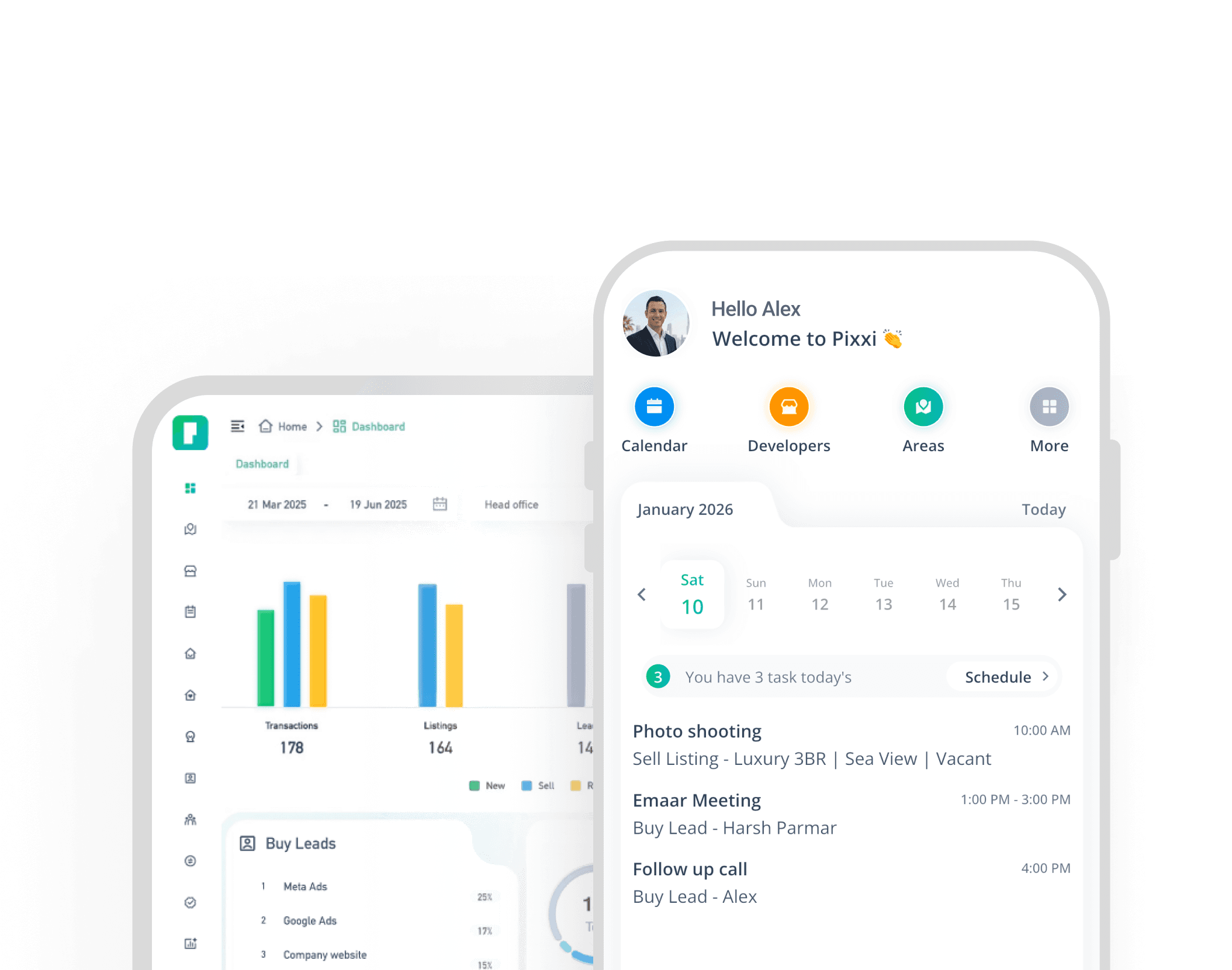
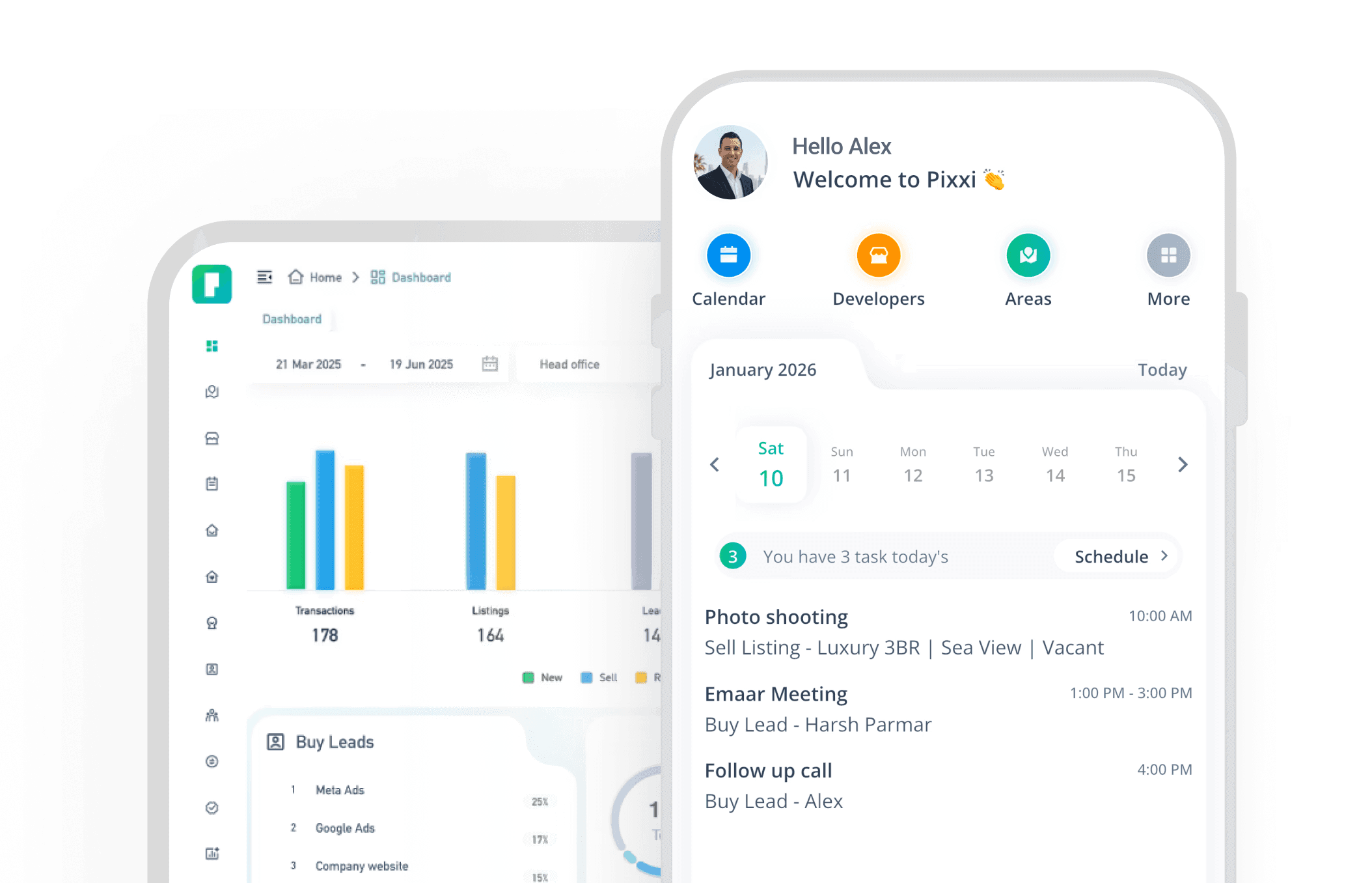
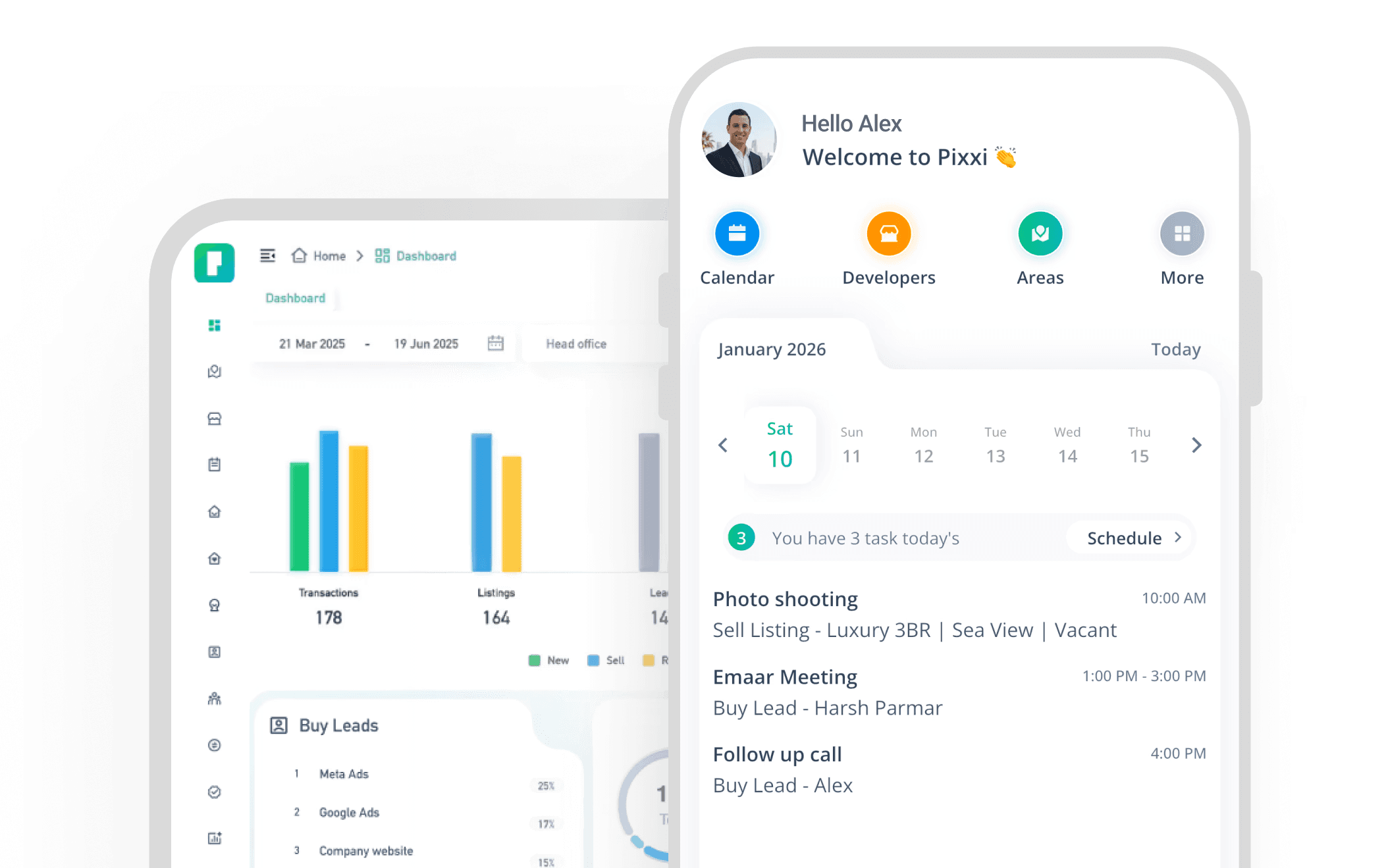
Brokerages can create structured lead distribution, manage listings, connect leads with inventory, track transactions and commissions, monitor performance and give agents mobile access to their work.
Instead of adding disconnected tools as the company grows, Pixxi provides a structured foundation that can support the wider brokerage operation.
Scale the Business, Not the Chaos
Growth exposes weaknesses.
If processes are already fragmented, doubling the size of the company can double the complexity.
But when the brokerage has clear workflows, centralized information and management visibility, technology can help the business grow without losing structure.
The question for brokerage leaders is therefore not only:
“How many agents can we hire?”
It is:
“Can our operation handle the brokerage we are becoming?”
The strongest companies build the infrastructure before complexity forces them to.
Build the structure behind your growth with Pixxi CRM one connected system for your leads, agents, listings, deals, commissions and performance.
Experience the fastest, most complete real estate CRM on mobile
With Pixxi, your entire business travels with you real-time updates, instant lead access, and seamless team communication.