Managing real estate agents comes with a difficult balance.
Leadership needs visibility.
Agents need autonomy.
Too little visibility and managers struggle to understand what is happening across leads, listings and deals.
Too much supervision and high-performing agents can feel like every move is being monitored.
The answer is not more check-ins, more WhatsApp messages or more meetings.
It is better data.
For growing UAE real estate brokerages, the right real estate CRM can create performance visibility without turning management into micromanagement.
Performance Is More Than the Number of Deals Closed
Transactions matter.
But looking only at closed deals tells you what already happened.
It does not always explain why it happened.
Two agents could close the same number of deals while having completely different pipelines.
One may have a healthy number of qualified opportunities progressing toward transactions.
Another may have very little activity behind their recent results.
This is why effective agent performance management needs to look beyond one final number.
Start With the Full Agent Journey
Real estate performance happens across multiple stages.
An agent receives leads.
They contact clients.
They follow up.
They manage requirements.
They work with listings.
They arrange viewings.
They negotiate.
They close transactions.
Instead of measuring isolated activities, management should understand how opportunities move through this journey.
This gives a much more useful picture of performance.
Stop Asking Agents for Constant Updates
A common management routine looks something like this:
“Did you contact this lead?”
“What happened with that client?”
“How many viewings do you have?”
“What's happening with this deal?”
These questions are reasonable.
But when managers need to ask them repeatedly, there is usually a visibility problem.
The information should already exist within the brokerage's operational system.
When agents maintain their activities and opportunities in a structured CRM, managers can access updates without constantly interrupting them.
Measure Conversion, Not Just Activity
More activity does not automatically mean better performance.
An agent could receive a large number of leads and generate very few meaningful opportunities.
Another may receive fewer leads but convert them more effectively.
That is why raw lead volume alone can be misleading.
Management should be able to understand how opportunities progress through the pipeline.
For example:
Leads Received → Contacted → Qualified → Viewing → Negotiation → Deal
Looking at progression helps identify where performance is strong and where support may be needed.
Lead Source Matters
Agent performance should also be viewed in context.
Not every lead source produces the same type or quality of inquiry.
If management evaluates agents only by total transactions without considering where their opportunities originated, the analysis can be incomplete.
Connecting lead sources with pipeline and transaction data helps brokerages understand both agent performance and marketing performance.
This creates better conversations between sales and marketing teams.
Look at Follow-Up Consistency
Real estate conversion often does not happen after one call.
Clients may take days, weeks or longer to make a decision.
That makes follow-up an important part of agent performance.
Managers do not necessarily need to monitor every call.
They need visibility into whether active opportunities are being managed consistently.
Are important leads sitting untouched?
Are follow-ups scheduled?
Are opportunities progressing?
Is the database being worked?
These indicators can reveal problems long before they appear in the final sales numbers.
Listings Are Part of Agent Performance Too
Real estate agents do more than manage leads.
For many brokerages, listings are an important part of their role.
Looking at listing activity alongside leads and transactions gives management a broader picture of an agent's contribution.
More importantly, when listings and leads exist within the same ecosystem, agents can work both sides of the business more effectively.
Performance becomes less about isolated activities and more about how well the agent uses the brokerage's overall database.
Don't Confuse Visibility With Surveillance
This distinction matters.
The purpose of CRM reporting should not be to monitor every minute of an agent's day.
It should help answer meaningful business questions.
Where are opportunities getting stuck?
Who needs more leads?
Who needs coaching?
Which agents are converting strongly?
Which teams have healthy pipelines?
Where is revenue likely to come from?
Good management data creates better decisions.
It should not create unnecessary pressure.
Use Data for Coaching
Performance data becomes particularly valuable when it is used to support agents rather than simply rank them.
Imagine an agent is receiving plenty of leads but very few are progressing to qualified opportunities.
That could indicate a problem with response time, qualification, communication or even lead quality.
Another agent may generate many viewings but struggle to move clients into negotiation.
That suggests a different coaching opportunity.
Without pipeline visibility, both agents may simply appear to be “not closing enough.”
Data helps managers identify where support is actually needed.
Recognize Top Performers More Accurately
Performance visibility is not only about identifying problems.
It also helps management understand what successful agents are doing well.
Top performers may demonstrate stronger conversion, better database management or more consistent progression through their pipelines.
These patterns can become valuable insights for the wider team.
Instead of relying entirely on anecdotal knowledge, leadership can use actual brokerage data to identify practices worth replicating.
Give Agents Visibility Into Their Own Performance
Performance data should not belong only to management.
Agents can also benefit from understanding their own pipeline and activity.
When people can clearly see their opportunities, priorities and progress, they can take greater ownership of their performance.
This shifts CRM from being perceived as a management reporting tool to becoming something useful for the agent.
That difference can significantly influence adoption.
Performance Reporting Should Be Real-Time
Traditional reporting often looks backward.
Teams prepare spreadsheets at the end of the week or month to explain what already happened.
A modern brokerage should aim for more immediate visibility.
If management can identify a pipeline issue today, there may still be time to act.
Waiting until the end of the month turns an operational problem into a historical report.
Real-time visibility helps management move from reporting to decision-making.
Connect Performance With Transactions and Commissions
Ultimately, activity should connect with business results.
When lead management, agent activity, transactions and commissions exist within the same system, leadership can see a more complete performance picture.
Instead of analyzing disconnected datasets, the brokerage can understand the journey from opportunity to revenue.
That is particularly important as teams become larger and management can no longer personally follow every transaction.
How Pixxi Helps Brokerages Understand Agent Performance
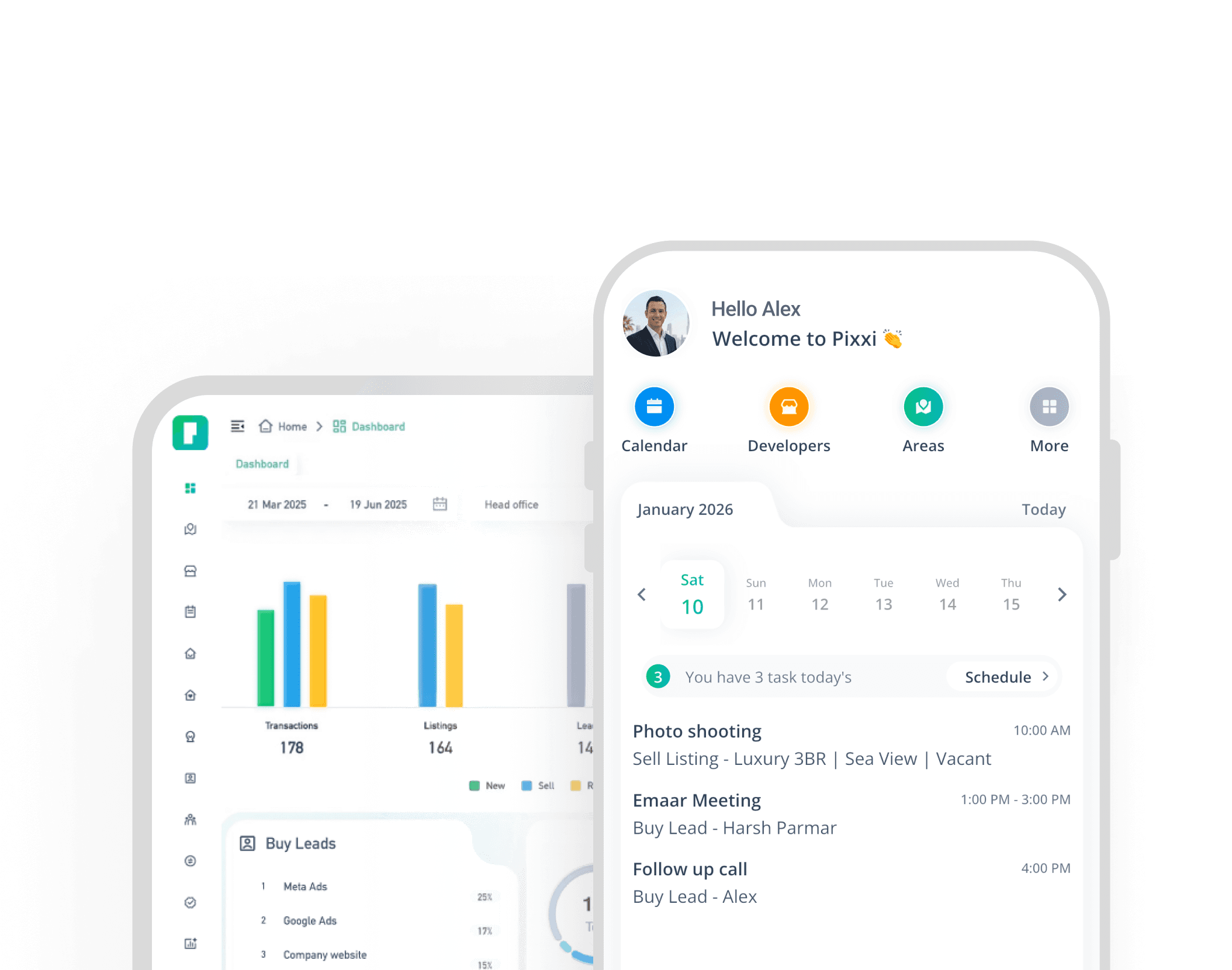
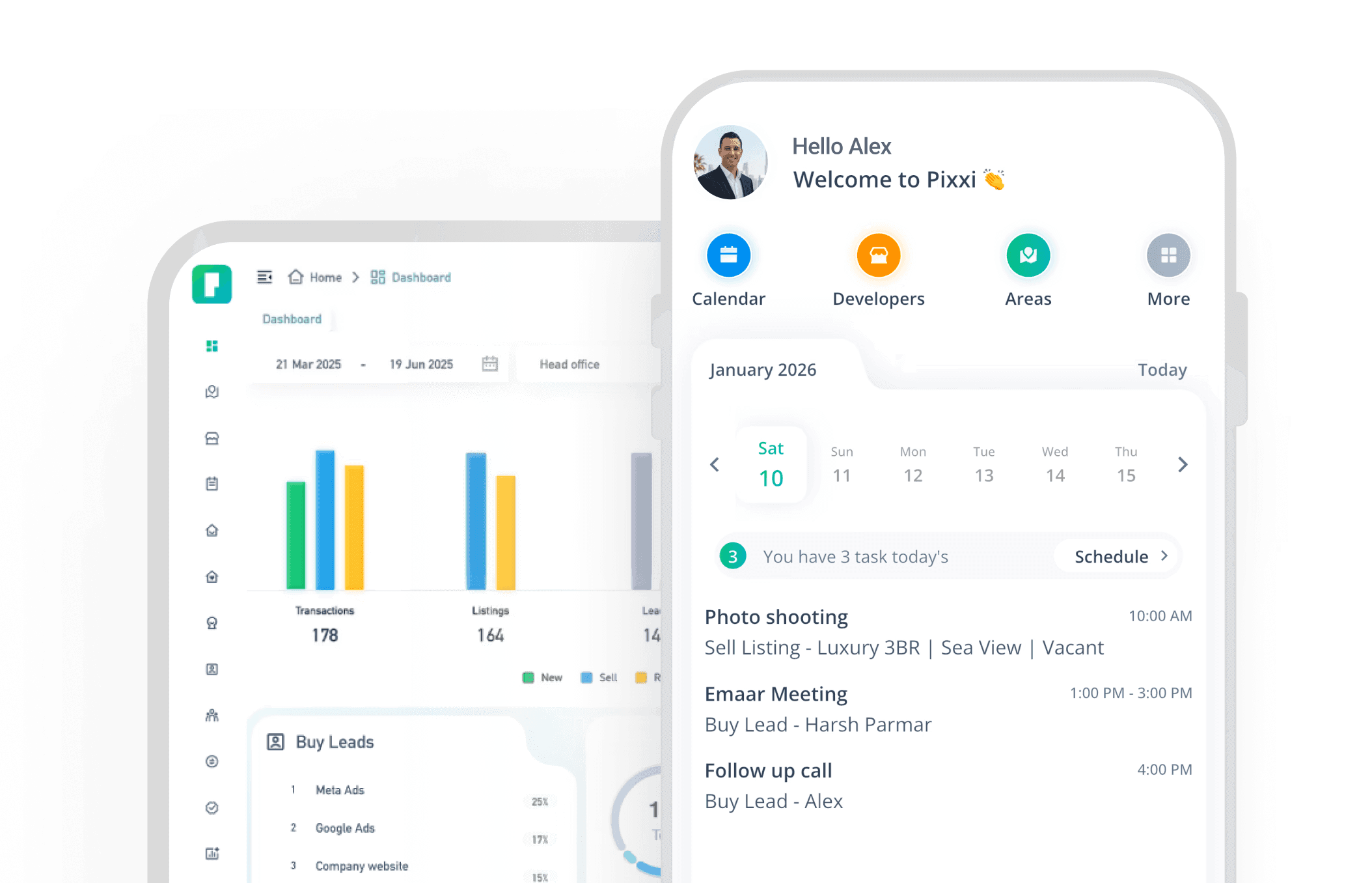
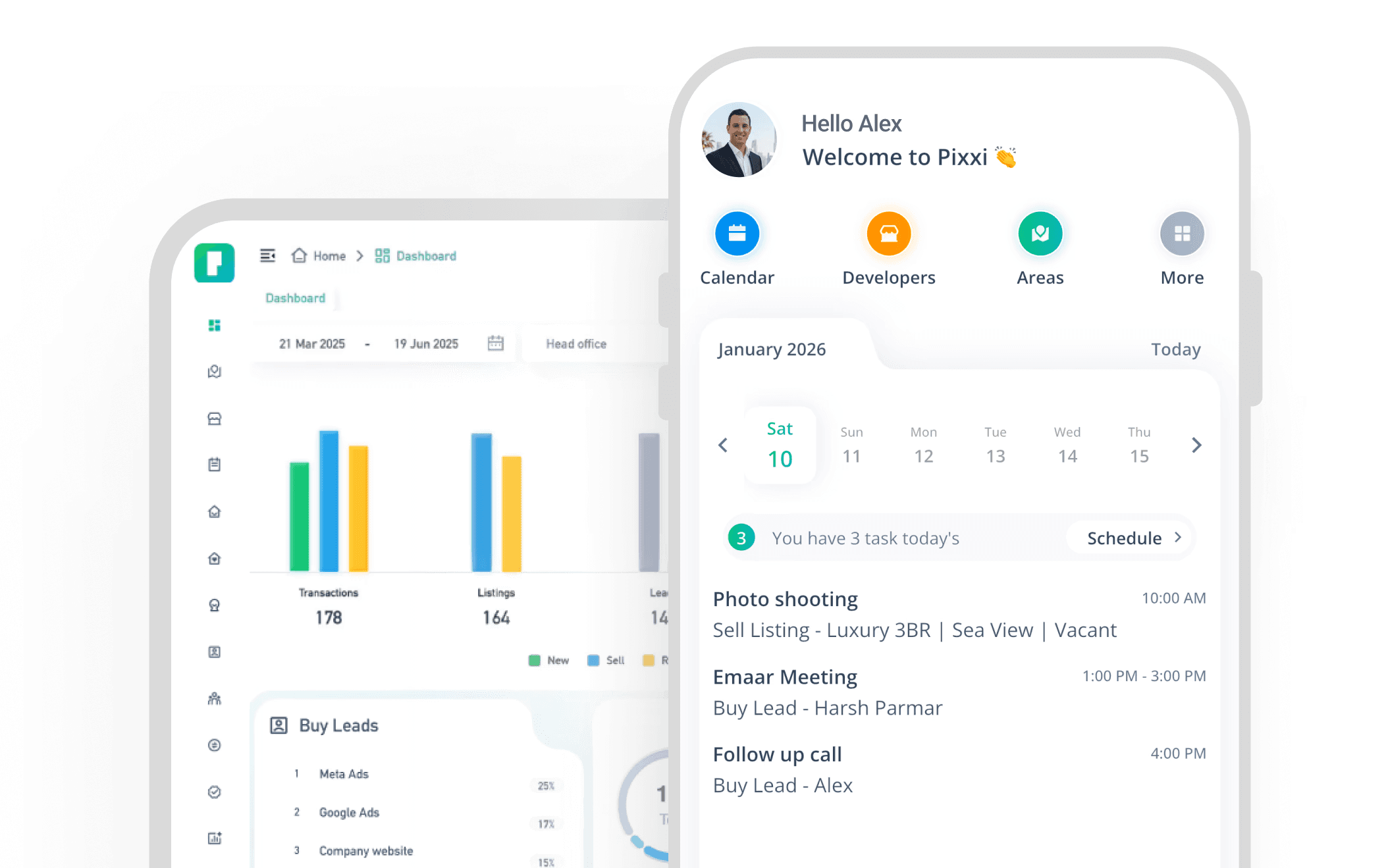
Pixxi CRM gives UAE real estate brokerages greater visibility across their operations.
Managers can understand activity across leads, agents, listings, deals, commissions and performance within one connected ecosystem.
Structured pipelines and performance insights help leadership see what is happening without depending entirely on manual reports and constant agent updates.
At the same time, agents have access to the information they need to manage their own work, including through the Pixxi mobile app.
The objective is not more monitoring.
It is better visibility for everyone.
Manage With Visibility, Not Micromanagement
As a brokerage grows, leadership cannot and should not personally supervise every activity.
The business needs systems that create transparency at scale.
Agents should have the freedom to do their jobs.
Managers should have the information required to lead.
And leadership should be able to understand performance without spending the entire day chasing updates.
That is the difference between managing people and building an operation.
KNOW WHAT'S HAPPENING ACROSS YOUR BROKERAGE.
Track leads, agents, listings, deals, commissions and performance in real time with Pixxi CRM.
Experience the fastest, most complete real estate CRM on mobile
With Pixxi, your entire business travels with you real-time updates, instant lead access, and seamless team communication.