A new property inquiry arrives.
Who sees it?
Who receives it?
How quickly does someone act?
And if the assigned agent doesn't respond, what happens next?
For UAE real estate brokerages generating leads from property portals, websites, advertising campaigns and other channels, lead response time is an operational KPI worth measuring.
But speed alone isn't enough.
A brokerage can respond quickly and still lose the opportunity because the lead wasn't properly qualified, followed up or matched with suitable inventory.
The better objective is:
Fast response + structured follow-up + measurable conversion.
Here's how to build that process.
What Is Lead Response Time?
Lead response time measures how long it takes a business to respond after receiving a new inquiry.
For a real estate brokerage, the journey may look like:
Inquiry received → Lead captured → Agent assigned → Agent notified → First action → Client contacted
The exact metric a brokerage uses should be clearly defined.
For example, does “response” mean:
The lead was assigned?
The agent opened it?
The agent attempted a call?
A WhatsApp message was sent?
The client actually responded?
A meaningful conversation took place?
These are not the same thing.
For useful reporting, management should define exactly what counts as a response.
Why Does Response Time Matter in Real Estate?
Property inquiries are often time-sensitive.
A buyer or tenant researching a property may contact more than one brokerage or explore several listings during the same search session.
A delayed response can therefore reduce the brokerage's opportunity to engage while the inquiry is active.
But the purpose of measuring response time isn't simply to tell agents:
“Call faster.”
It is to identify whether the company's operating process allows agents to respond efficiently.
A slow response may be caused by:
Delayed lead capture
Manual assignment
Incorrect routing
Agents being unavailable
Leads arriving outside working hours
Notifications being missed
Unclear ownership
No escalation process
These are operational problems, not simply agent-performance problems.
What Is a Good Real Estate Lead Response Time?
There is no single response-time benchmark that is appropriate for every UAE brokerage, lead source or operating model.
A portal inquiry received during working hours may require a different internal target from an inquiry received overnight.
An off-plan campaign may also operate differently from a rental inquiry.
Instead of copying an arbitrary benchmark, establish your own service-level target.
For example, management can define:
During working hours: new inquiries should receive an initial action within the company's agreed response window.
Outside working hours: inquiries should follow a separate on-call, automation or next-working-period process.
The important thing is that the rule is:
Defined → Measured → Managed
The Real Problem: The Clock Often Starts Before the Agent Sees the Lead
Imagine an inquiry arrives at 2:00 PM.
It reaches an inbox.
At 2:07 PM, an administrator notices it.
At 2:12 PM, the lead is forwarded to a team leader.
At 2:18 PM, the team leader decides which agent should receive it.
At 2:22 PM, the agent sees the message.
The agent calls immediately.
From the agent's perspective, response time was excellent.
From the client's perspective, 22 minutes have already passed.
This is why lead-response performance needs to measure the whole process, not just agent behavior.
Step 1: Capture Leads Automatically
The first opportunity for improvement is lead capture.
If inquiries need to be manually copied from different channels into a spreadsheet or CRM, response time already depends on someone noticing them.
Where supported, integrations can allow inquiries to enter the CRM automatically.
The system can then record information such as:
Lead source
Time received
Client details
Property of interest
Campaign or listing reference
This creates a reliable starting point for measuring response time.
Step 2: Automatically Assign the Lead
The second potential delay is assignment.
If every inquiry needs to wait for a manager to decide which agent should receive it, the brokerage creates an unnecessary bottleneck.
Automated lead distribution can help assign inquiries according to predefined rules.
Depending on the brokerage, those rules may consider:
Team
Working hours
Agent availability
Lead source
Language
Area
Property specialization
Rotation order
This removes part of the manual process.
Step 3: Notify the Agent Immediately
Assignment only works if the responsible person knows that a new opportunity has arrived.
A CRM should provide a clear notification process.
Agents should not need to continuously check several portals, inboxes or spreadsheets to discover whether they have received a new lead.
The goal is:
Lead received → Assigned → Agent notified
with as little unnecessary delay as possible.
Step 4: Define Lead Acceptance
A useful brokerage process distinguishes between:
Lead assigned
and
Lead actioned.
These are different events.
Management may want the agent to accept or take an initial action on the lead within a defined period.
This creates accountability.
If the agent is unavailable, management doesn't have to discover that hours later.
Step 5: Create an Escalation Process
This is where lead rotation becomes particularly valuable.
What should happen when an assigned agent doesn't take the required action?
The brokerage might choose to:
Notify the agent again
Alert the team leader
Return the lead to a shared pool
Reassign the lead
Escalate according to internal rules
There isn't one universal answer.
But there should be an answer.
A lead-management process without escalation relies heavily on individual behavior.
Step 6: Consider Working Hours
Real estate inquiries do not necessarily arrive during office hours.
Brokerages should therefore decide how leads received:
Early morning
Late evening
Overnight
Weekends
Public holidays
will be handled.
Possible approaches include:
Defined agent shifts
On-call teams
Automated acknowledgement
Working-hour-based lead rotation
Next-business-period assignment
The correct model depends on the company.
What matters is that it is deliberate.
Speed Without Qualification Isn't Enough
Imagine two agents.
Agent A
Responds in two minutes but doesn't properly understand the client's requirements.
Agent B
Responds slightly later but qualifies the client's budget, location, timeline and property requirements and schedules the next action.
Who handled the opportunity better?
Response time alone cannot answer that.
This is why management should avoid turning speed into an isolated vanity metric.
The objective is not:
Fastest agent wins.
It is:
Respond efficiently and move the opportunity forward.
What Happens After the First Response?
This is where many lead-management strategies become too focused on speed.
The first response is only the beginning.
The next stages may include:
Contact
↓
Qualification
↓
Property matching
↓
Follow-up
↓
Viewing
↓
Negotiation
↓
Transaction
A fast initial response with no structured follow-up creates little value.
Follow-Up Is Part of Response Management
Not every client will answer the first call.
That doesn't necessarily mean the lead is lost.
A brokerage should define how unanswered inquiries are handled.
The CRM can help agents maintain:
Contact attempts
Notes
Follow-up tasks
Next-action dates
Lead statuses
This prevents opportunities from depending entirely on agent memory.
Measure Response Time by Lead Source
Not all lead channels necessarily behave the same way.
Management should analyze response and conversion across sources such as:
Property portals
Website
Meta campaigns
Google campaigns
Referrals
Existing databases
Direct inquiries
This can reveal operational differences.
For example, one source may generate high volumes of inquiries that require rapid qualification.
Another may generate fewer but more developed opportunities.
The purpose is not simply to identify the “best” source.
It is to understand how each source behaves throughout the funnel.
Measure More Than Response Time
A useful lead-performance dashboard should go beyond one number.
Lead Volume
How many inquiries were received?
Assignment Time
How long did it take for a lead to receive an owner?
First-Action Time
How long before the assigned agent took action?
Contact Rate
How many inquiries resulted in successful contact?
Qualification Rate
How many became qualified opportunities?
Follow-Up Completion
Are scheduled actions being completed?
Viewing Rate
How many qualified leads progress to viewings?
Transaction Conversion
How many leads ultimately contribute to completed transactions?
Lost Reasons
Why are opportunities not progressing?
Together, these metrics tell a much more useful story.
Don't Compare Agents Using Response Time Alone
Agent performance should be evaluated carefully.
One agent may receive highly qualified inquiries.
Another may receive a large volume of lower-intent leads.
One team may handle rentals.
Another may handle luxury off-plan sales with a much longer sales cycle.
So instead of ranking employees based on one metric, management should evaluate performance within the relevant operational context.
Response time is a useful signal.
It isn't the complete performance picture.
How to Improve Real Estate Lead Response Time
For most brokerages, improvement comes from removing unnecessary delays.
Start with these questions:
Capture: Are leads entering the CRM automatically?
Assignment: Is someone manually distributing every inquiry?
Notification: Does the agent know immediately?
Ownership: Is it clear who is responsible?
Escalation: What happens if they don't act?
Working hours: What happens outside office hours?
Follow-up: Does every active lead have a next action?
Reporting: Can management measure all of this?
Fixing these operational gaps can improve response management without simply putting more pressure on agents.
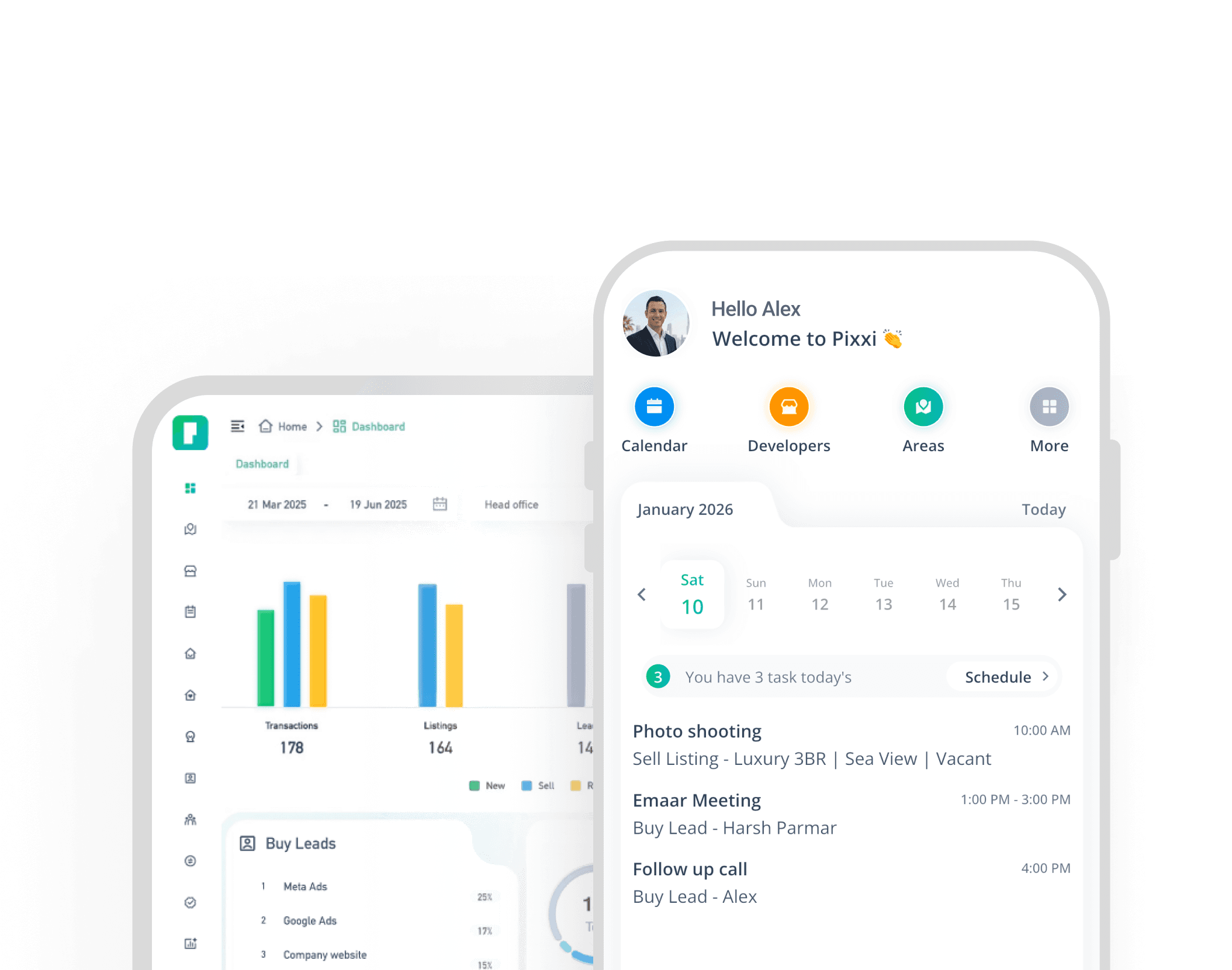
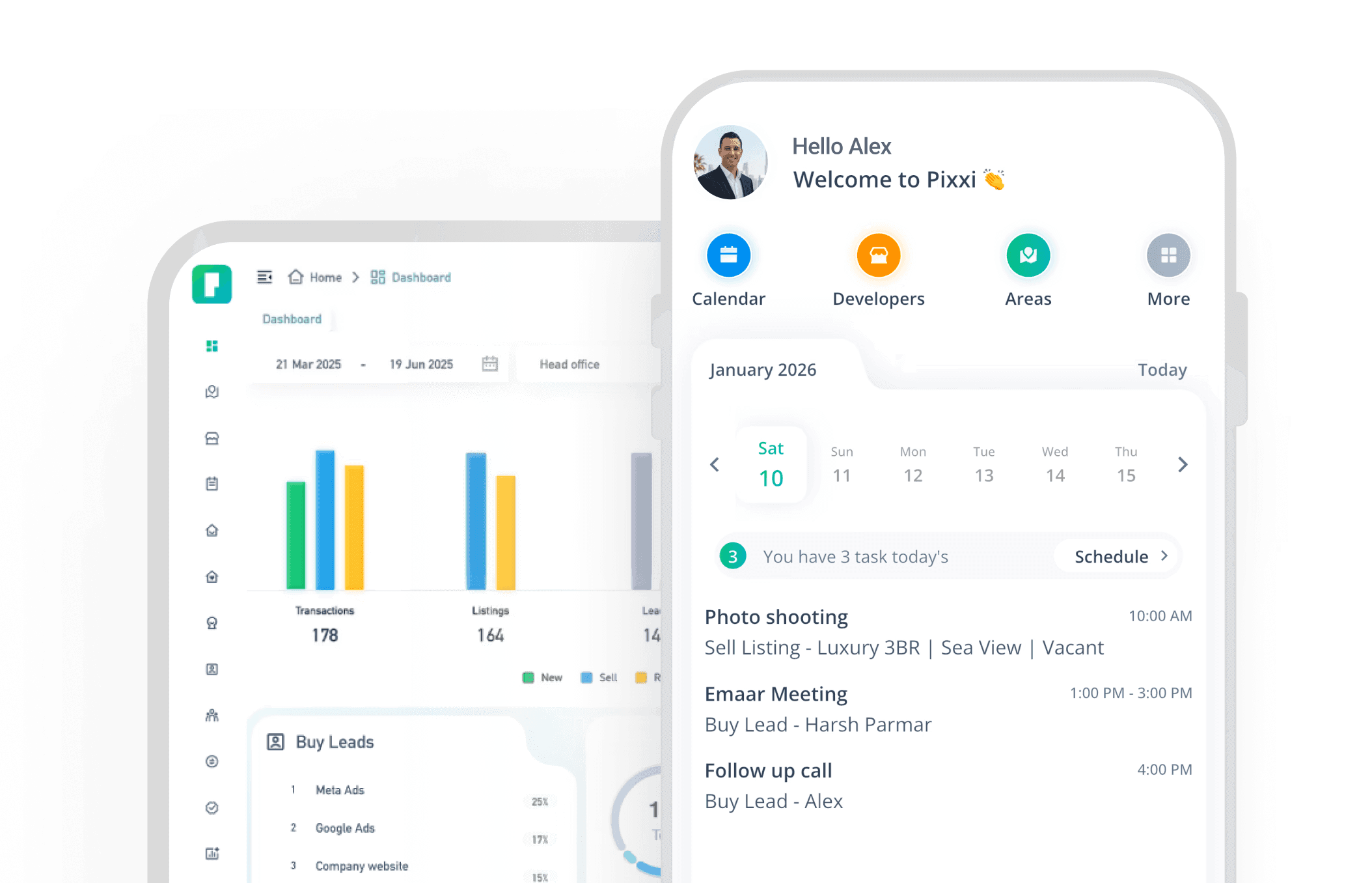
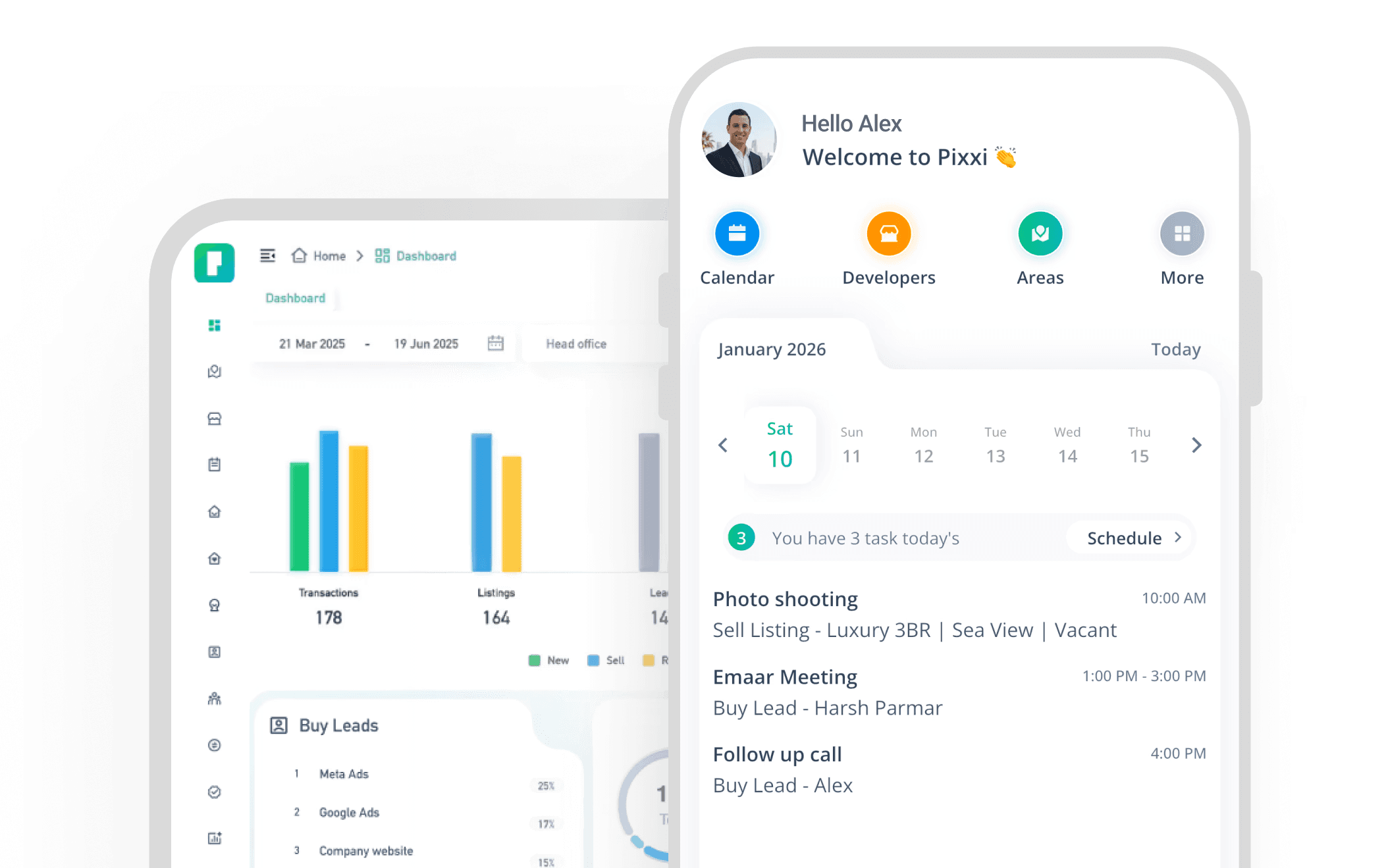
How Pixxi Lead Rotation Works
Pixxi CRM is designed around real estate lead-management workflows.
Incoming leads can be centralized and distributed to agents using configured lead-rotation rules.
Brokerages can define elements such as agent eligibility and working hours according to their operating process.
The objective is to move from:
Lead arrives → Someone manually decides what to do
to a structured workflow:
Lead arrives → Pixxi assigns → Agent notified → Action tracked
If the required action isn't taken according to the configured process, the brokerage can use its lead-management workflow to prevent inquiries from remaining unattended.
This gives management greater visibility over lead ownership and activity.
From Response Time to Revenue
The most valuable question isn't:
“How fast did we respond?”
It is:
“What happened to the lead?”
The complete picture is:
Source → Response → Qualification → Viewing → Transaction → Commission
When these stages are connected, a brokerage can start understanding which sources, teams and processes contribute to actual business outcomes.
That is much more valuable than celebrating a fast first call.
Frequently Asked Questions
What is lead response time in real estate?
Lead response time is the period between receiving a new inquiry and the first defined response or action from the brokerage.
What is a good response time for a real estate lead?
There is no universal response-time target suitable for every brokerage. Companies should define an internal target based on lead source, working hours, team structure and operating model, then measure performance consistently.
Does responding faster guarantee a real estate sale?
No. Response speed is only one part of lead management. Qualification, inventory, follow-up, agent capability, client intent and other factors also affect conversion.
What is automatic lead assignment?
Automatic lead assignment uses predefined rules to allocate incoming inquiries to eligible agents without requiring each lead to be manually distributed.
What is lead rotation?
Lead rotation is a method of distributing inquiries among eligible agents according to predefined rules. It can help create a more structured and consistent allocation process.
What happens if an agent doesn't respond to a lead?
A brokerage should define an escalation process. Depending on its workflow and CRM capabilities, this might involve notifications, manager escalation, returning the lead to a pool or reassignment.
Can Property Finder and Bayut leads be automatically distributed?
With supported portal and CRM integrations, incoming portal leads can enter a centralized CRM and then be distributed according to configured lead-assignment rules.
Speed Matters. Process Matters More.
Fast response is valuable.
But the strongest UAE real estate brokerages shouldn't optimize for a stopwatch alone.
They should optimize the entire lead journey:
Capture quickly.
Assign clearly.
Respond efficiently.
Qualify properly.
Follow up consistently.
Measure outcomes.
That's how response time becomes part of a scalable sales operation rather than simply another KPI on a dashboard.
Pixxi CRM helps UAE real estate brokerages centralize incoming leads, automate lead distribution, manage follow-ups and give management greater visibility over agent activity and lead progression.
Want to see how lead rotation and response management work inside Pixxi? Book a demo with our team.
Experience the fastest, most complete real estate CRM on mobile
With Pixxi, your entire business travels with you real-time updates, instant lead access, and seamless team communication.