A growing Dubai real estate brokerage can quickly accumulate technology.
A CRM.
Property portals.
WhatsApp.
A website.
Advertising platforms.
Call systems.
Spreadsheets.
Analytics.
Automation tools.
Document storage.
And eventually, the company may discover that it has plenty of software — but very little of it works together.
The objective of a good real estate technology stack isn't to have more tools.
It's to create a connected operating environment where:
Leads → Agents → Properties → Communication → Viewings → Transactions → Commissions → Management data
can move through a structured process.
So what technology does a growing Dubai real estate brokerage actually need?
What Is a Real Estate Tech Stack?
A real estate tech stack is the combination of technology a brokerage uses to operate its business.
For a UAE real estate company, this may include:
CRM
Property portals
Website
Communication tools
Calling/telephony
Advertising platforms
Automation
Analytics
Document management
Finance/accounting systems
The important word is stack.
These tools shouldn't be evaluated only individually.
Brokerages should also consider how information moves between them.
The Core Principle: Build Around the Customer Journey
Before buying software, map the journey.
For example:
Client sees advertisement
↓
Client submits inquiry
↓
Lead enters CRM
↓
Agent receives lead
↓
Agent contacts client
↓
Requirements are qualified
↓
Suitable property identified
↓
Viewing arranged
↓
Negotiation
↓
Transaction
↓
Commission
↓
Reporting
Every technology decision should make one or more stages of this journey easier to manage.
If a tool creates another disconnected database, another login and another manual process, it may be adding complexity rather than reducing it.
Layer 1: Real Estate CRM
The CRM should sit at the center of the brokerage's commercial operation.
This is where the company manages relationships and activity across:
Leads
Clients
Owners
Agents
Listings
Properties
Activities
Viewings
Transactions
Commissions
For a growing brokerage, the CRM should become the company's operational source of truth.
What should you look for?
For UAE real estate operations, consider capabilities such as:
Centralized lead capture
Lead assignment
Lead rotation
Follow-up management
Property listings
Owner database
Off-plan projects
Transactions
Commissions
Tasks
Permissions
Approval workflows
Agent KPIs
Team reporting
Mobile access
The most important test isn't the number of features.
Ask:
Can this CRM support the way our brokerage actually operates?
Layer 2: Property Portals
Property portals are a major part of the UAE real estate ecosystem.
Brokerages may use platforms such as Property Finder and Bayut to market inventory and generate inquiries.
From a technology perspective, the key question is:
What happens when the portal generates a lead?
Ideally:
Portal inquiry → CRM → Agent assignment → Follow-up → Reporting
rather than:
Portal inquiry → Inbox → Manual forwarding → Spreadsheet → Agent
The fewer unnecessary manual steps, the easier the process becomes to manage.
Don't Measure Portals Only by Lead Volume
Portal performance should eventually connect with downstream outcomes.
Management should aim to understand:
Portal → Leads → Qualified opportunities → Viewings → Transactions
This provides much more useful information than inquiry volume alone.
Layer 3: Brokerage Website
A brokerage website should do more than display properties and company information.
It should contribute to the wider sales infrastructure.
A useful website may support:
Property discovery
Lead generation
Agent profiles
Area information
Developer/project content
Seller/landlord inquiries
Buyer/tenant inquiries
Organic search traffic
Campaign landing pages
Most importantly, website inquiries should flow into the same lead-management process as other sources.
You don't want:
Website leads in one inbox
and
portal leads somewhere else.
The CRM should ideally provide management with one centralized picture.
Layer 4: WhatsApp and Communication
WhatsApp is an important communication channel in the UAE real estate market.
But it creates a technology challenge.
When client communication happens entirely through individual agent phones, management visibility can become limited.
Important client context may remain outside the company's central system.
Brokerages should therefore think about communication strategically.
Questions to consider include:
How are WhatsApp conversations managed?
Who owns the communication history?
What happens when an agent leaves?
Can relevant interactions be connected with CRM records?
How are communication permissions handled?
What communication processes need company oversight?
The objective isn't to make communication less personal.
It's to prevent valuable business information from becoming fragmented.
Layer 5: Business Calling / VOIP
Phone calls remain important in real estate.
For a growing team, business telephony can provide advantages over relying entirely on personal mobile numbers.
Depending on the setup, a business calling system may help with:
Call routing
Business numbers
Call logs
Team management
Performance visibility
CRM connectivity
The most useful architecture is one where relevant calling activity can be associated with the client journey.
That gives management a more complete picture of agent activity.
Layer 6: Marketing Platforms
Most growing brokerages eventually invest in digital advertising.
Common channels can include:
Meta
Google
TikTok
YouTube
But advertising platforms should not become separate islands.
A useful marketing architecture looks like:
Advertisement → Lead → CRM → Agent → Qualification → Viewing → Transaction
The closer the company gets to connecting marketing activity with business outcomes, the better management can understand acquisition performance.
Move Beyond Cost Per Lead
Cost per lead is useful.
But it isn't the final objective.
Consider:
Campaign A
100 leads at AED 50 each.
Campaign B
50 leads at AED 80 each.
Campaign A appears cheaper.
But what if Campaign B generates more qualified opportunities and more transactions?
The important question becomes:
Which marketing activity contributes to actual business?
That requires CRM data.
Layer 7: Automation
Automation becomes useful when the company has already defined its processes.
Potential examples include:
Lead routing
Agent notifications
Follow-up tasks
Internal alerts
Workflow triggers
Data transfer between applications
Tools such as Zapier can also help connect supported applications when direct integrations aren't available.
But automation should follow a simple rule:
Don't automate a process you haven't defined.
Otherwise, technology simply makes a bad process happen faster.
Layer 8: Analytics and Management Reporting
Every brokerage eventually needs to answer questions such as:
How many leads did we receive?
Where did they come from?
How quickly were they handled?
How many were qualified?
How many resulted in viewings?
How many became transactions?
Which agents are performing?
Which teams are performing?
Which sources generate business?
Which inventory is moving?
This is why the CRM and other operational systems need structured data.
Without reliable input, dashboards become decoration.
The Management Dashboard Should Answer Business Questions
Avoid building dashboards simply because the data exists.
Start with the decision.
For example:
Question: Are portal leads being handled efficiently?
Then track:
Lead volume → Assignment → Response → Qualification → Viewing → Transaction
Question: Which agents need support?
Then analyze:
Lead volume → Activities → Follow-ups → Viewings → Conversion
Technology should help management make decisions.
Layer 9: Document Management
Real estate operations generate documents.
Depending on the transaction and company process, teams may need to manage:
Client documents
Property documents
Agreements
Transaction documents
Internal approvals
Supporting files
A growing brokerage should define where these documents live and who can access them.
Important files shouldn't be spread randomly across:
WhatsApp + personal laptops + email + shared drives + CRM
without a clear structure.
The company should establish a controlled document process.
Layer 10: Accounting and Finance
The CRM doesn't necessarily need to become the accounting system.
These are different functions.
The CRM can manage the commercial journey:
Lead → Transaction → Commission
while accounting software manages areas such as:
Invoices → Expenses → Payments → Financial statements
The important consideration is how information moves between commercial operations and finance.
As the brokerage grows, repeatedly entering the same transaction into multiple systems becomes inefficient and increases the risk of inconsistency.
Layer 11: Database Management
One of the most valuable assets a brokerage builds over time isn't software.
It's data.
A growing company may accumulate:
Buyers
Tenants
Sellers
Landlords
Investors
Owners
Past clients
Portal leads
Campaign leads
Referrals
Without structure, that database becomes a large collection of old contacts.
With structure, it becomes a business asset.
The CRM should help teams understand:
Who is this person?
What were they looking for?
Who spoke to them?
When were they last contacted?
What properties were discussed?
What should happen next?
Layer 12: AI
AI is increasingly becoming another layer of the real estate technology stack.
Potential applications can include:
Lead qualification assistance
Conversation summaries
Property descriptions
Database segmentation
Property matching
Management insights
Marketing content
Workflow assistance
But brokerages shouldn't adopt AI simply because a product includes the label.
Ask:
What specific problem does this solve?
And:
Does it use reliable business data?
AI becomes much more valuable when the company's underlying CRM data is already structured.
Poor data + AI doesn't automatically create better decisions.
What Should a 5-Agent Brokerage Use?
Keep the stack simple.
Prioritize:
1. CRM
2. Property portals
3. Website
4. Business communication
5. Basic marketing
6. Accounting
Avoid buying enterprise-level systems before the operational need exists.
Your priority should be adoption.
What Should a 20–50 Agent Brokerage Use?
At this stage, automation and management visibility become more important.
Consider:
CRM
Automated lead distribution
Portal integrations
Centralized listings
WhatsApp/business communication
VOIP
Website integration
Marketing integrations
Workflow automation
Management dashboards
Structured document management
Accounting
This is where disconnected tools can start becoming expensive operationally.
What Should a 50+ Agent Brokerage Use?
At larger scale, technology architecture becomes increasingly important.
Management may need:
Multiple teams
Departments
Branches
Advanced permissions
Lead routing
Approval workflows
Large databases
Transaction control
Commission structures
Management dashboards
Marketing attribution
Integration architecture
Data governance
At this point, technology is no longer simply a collection of tools.
It becomes part of company infrastructure.
Example Dubai Real Estate Technology Architecture
A simple architecture could look like:
Property Finder / Bayut / Website / Ads
↓
CRM
↓
Lead Assignment + Agent Workflow
↓
Communication + Calling
↓
Listings + Property Database
↓
Viewings + Transactions + Commissions
↓
Management Analytics
Alongside:
Automation
Documents
Accounting
AI
The CRM becomes the connecting layer between customer acquisition and brokerage operations.
Common Tech Stack Mistakes
Mistake 1: Buying Too Many Tools
More software doesn't automatically mean more productivity.
Mistake 2: Choosing Tools Without Checking Integrations
A great standalone tool can still create operational problems if it cannot communicate with the rest of the stack.
Mistake 3: Keeping Excel as a Parallel Operating System
Spreadsheets remain useful, but requiring teams to update both the CRM and Excel creates duplication.
Mistake 4: Ignoring Agent Experience
If technology makes everyday tasks unnecessarily difficult, adoption will suffer.
Mistake 5: Automating Before Defining the Process
Automation cannot fix an unclear workflow.
Mistake 6: Measuring Activity Without Outcomes
Calls and leads matter.
Transactions matter more.
Connect the two.
How Pixxi Fits Into a UAE Real Estate Tech Stack
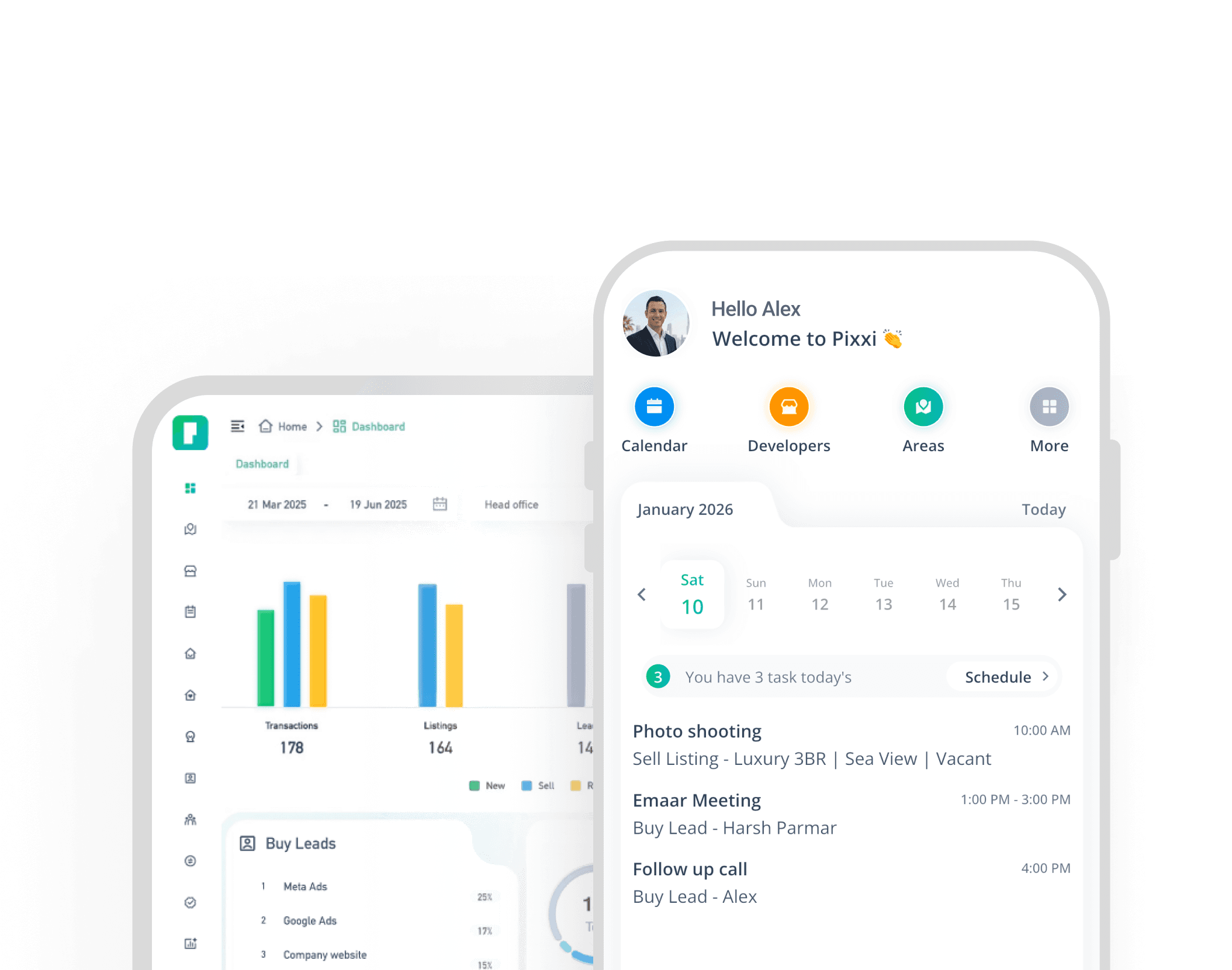
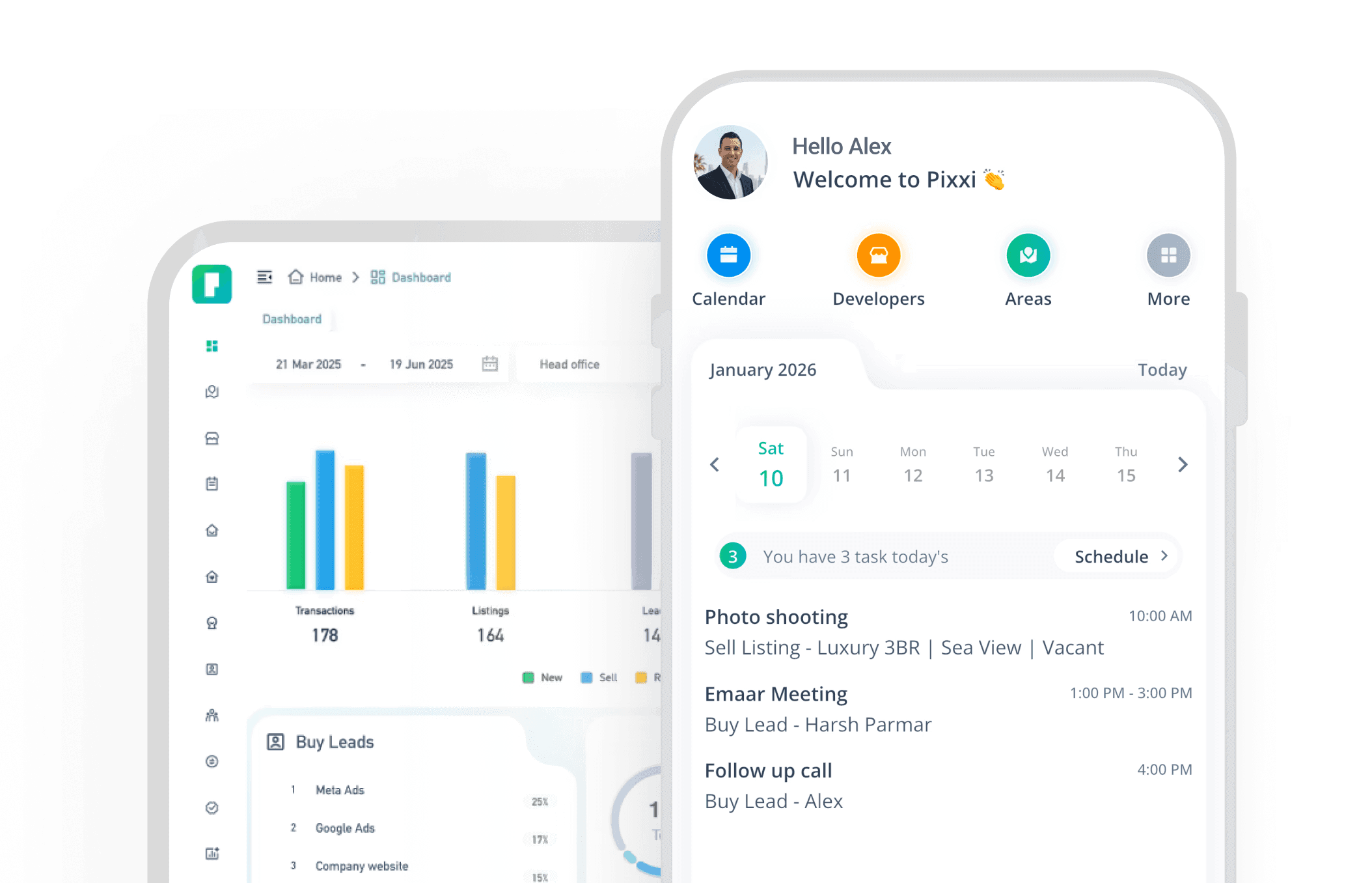
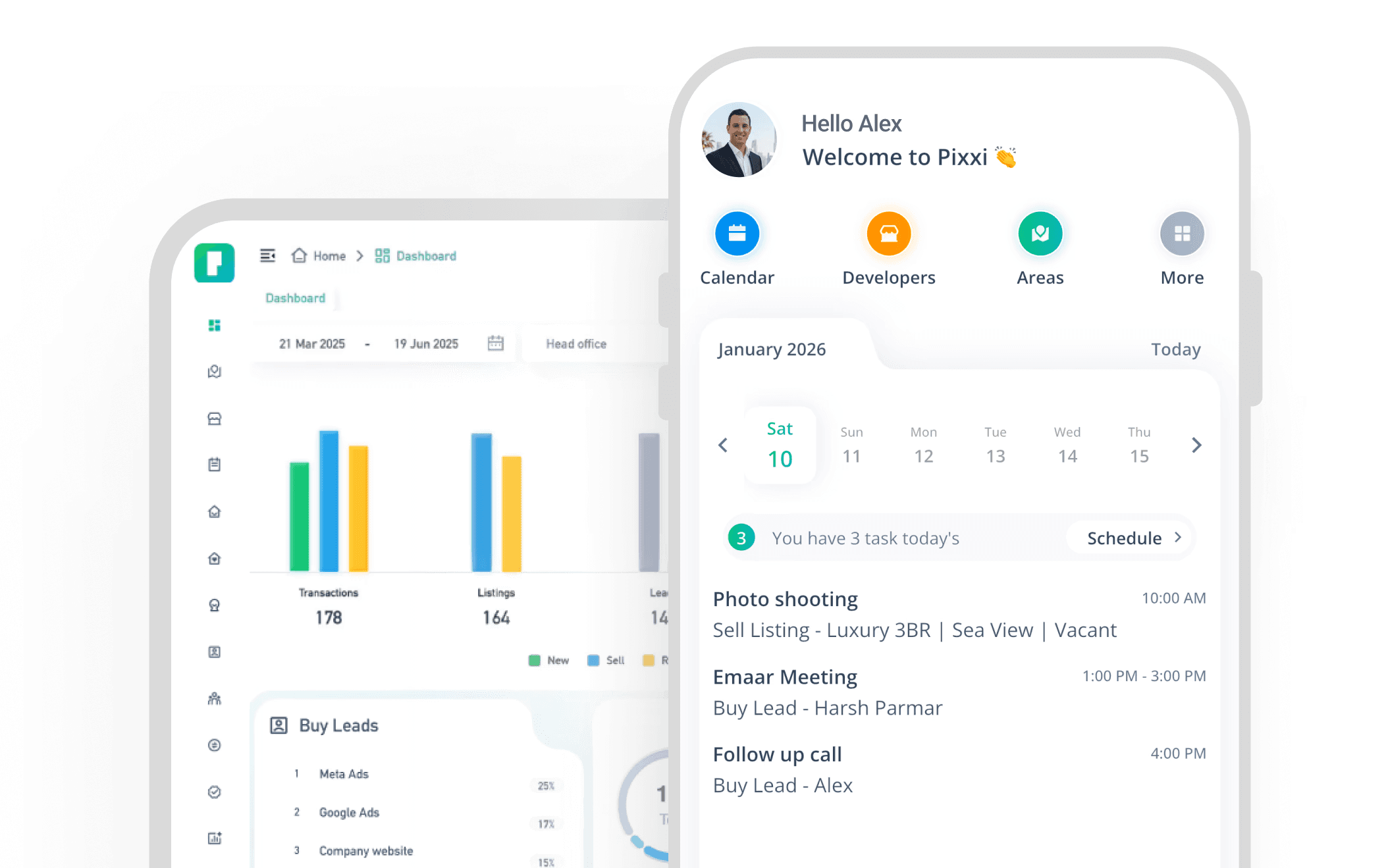
Pixxi CRM is designed to operate as the central real estate management layer within a UAE brokerage's technology stack.
Pixxi brings together areas including:
Lead management
Lead rotation
Listings
Owners
Off-plan projects
Database management
Transactions
Commissions
Tasks
Approvals
Permissions
Agent and team KPIs
Management insights
Mobile access
Pixxi also supports connections with key tools and channels used by UAE real estate companies, including property portals, websites, communication platforms and automation tools.
The objective is to reduce fragmentation between:
Lead generation
and
Brokerage operations.
How to Audit Your Existing Tech Stack
Create a list of every system your brokerage currently uses.
Then ask five questions about each one:
1. What problem does this tool solve?
If nobody knows, reconsider it.
2. Who actually uses it?
Purchased software and adopted software are very different things.
3. Where does its data go?
Does it connect with the CRM or create another isolated database?
4. Are we entering the same information twice?
Duplicate work is often a sign of poor integration.
5. What would happen if we removed it?
If the answer is “nothing,” you may not need it.
Don't Build a Collection of Tools. Build a System.
The best real estate technology stack isn't the one with the most software.
It's the one where information moves naturally through the company.
Lead generated
↓
Lead captured
↓
Agent assigned
↓
Client qualified
↓
Property matched
↓
Viewing arranged
↓
Transaction completed
↓
Commission calculated
↓
Management understands what happened
Technology should make that journey easier to manage, easier to measure and easier to scale.
For growing Dubai brokerages, the goal should therefore be:
Fewer disconnected systems.
Better data.
Clearer workflows.
More management visibility.
Pixxi CRM is built specifically around UAE real estate operations and can act as the central layer connecting these workflows.
If you're reviewing your brokerage's technology stack, book a Pixxi demo and bring your current workflow. We'll show you where Pixxi can fit.
FAQ
What software does a Dubai real estate brokerage need?
Most brokerages need a combination of CRM, property portals, website, communication tools, marketing systems, document management and accounting. The exact stack depends on the company's size and operating model.
What is the most important software for a real estate brokerage?
For many growing brokerages, the CRM becomes the central operational platform because it connects leads, clients, agents, properties, activities and transactions.
Do real estate agencies need both CRM and property portals?
They serve different purposes. Property portals help advertise inventory and generate inquiries, while CRM software helps the brokerage manage those inquiries and the wider client journey.
Can WhatsApp be connected to a real estate CRM?
Some CRM and communication platforms support integrations that connect WhatsApp-related workflows with customer records. Exact functionality depends on the providers and configuration.
Can Property Finder and Bayut integrate with CRM?
Supported real estate CRM integrations can help centralize portal-generated inquiries and, depending on the integration, support listing-related workflows.
Should a small brokerage use the same technology as a 100-agent company?
Not necessarily. Smaller brokerages should prioritize simplicity and adoption. Larger companies typically require stronger permissions, automation, workflows, reporting and integration architecture.
Where does AI fit into a real estate brokerage?
AI can support areas such as content, summarization, qualification, matching and analytics, but it is most useful when the brokerage already has structured and reliable underlying data.
Experience the fastest, most complete real estate CRM on mobile
With Pixxi, your entire business travels with you real-time updates, instant lead access, and seamless team communication.