Why Excel and WhatsApp Are Not Enough to Run a Growing Real Estate Brokerage
Excel and WhatsApp are probably two of the most useful tools inside any real estate company.
And that is exactly why brokerages become so dependent on them.
A spreadsheet is created to track leads.
A WhatsApp group is opened for listings.
Another spreadsheet manages commissions.
Agents keep client conversations on their phones.
Managers request updates through messages.
Before long, a significant part of the brokerage is being operated through tools that were never designed to manage an entire real estate business.
For a small team, this may work.
For a growing brokerage, it eventually creates a serious question:
Do you actually have visibility over your operation?
Excel Isn't the Problem
Spreadsheets are powerful.
They are flexible, familiar and excellent for many business tasks.
The problem starts when a spreadsheet becomes the operating system of the brokerage.
Real estate information constantly changes.
New leads arrive.
Listings become available or unavailable.
Agents follow up with clients.
Viewings happen.
Negotiations progress.
Deals close.
Commissions change.
Trying to maintain all of this through manually updated spreadsheets creates increasing operational pressure as the company grows.
WhatsApp Isn't the Problem Either
WhatsApp is fundamental to communication in the UAE real estate industry.
Agents use it constantly to communicate with buyers, tenants, owners, colleagues and managers.
That is not likely to change.
But communication and operational management are two different things.
A message can tell you something happened.
It does not necessarily create a structured record of what happened across the business.
Important information can quickly disappear inside hundreds of conversations.
And management cannot realistically scroll through messages to understand the state of every lead, listing or transaction.
The Real Problem Is Fragmentation
The challenge appears when different parts of the brokerage exist in different places.
Leads in spreadsheets.
Listings in another database.
Client conversations on individual phones.
Deals in shared files.
Commissions in finance sheets.
Tasks in calendars.
Performance reports somewhere else.
Each tool may work independently.
But the brokerage itself becomes disconnected.
This creates one of the biggest challenges for growing real estate companies:
No single source of truth.
What Happens When a New Lead Arrives?
Consider something as simple as a new inquiry.
The lead arrives from a property portal or marketing campaign.
What happens next?
Someone may need to forward it.
An agent receives it.
The agent contacts the client.
A note may be added to a spreadsheet.
Follow-up may happen through WhatsApp.
A viewing could be arranged.
A manager might later ask for an update.
Every step happened.
But where is the complete journey recorded?
If understanding one lead requires checking several tools and asking the agent directly, the brokerage does not have true lead visibility.
Multiply that by hundreds or thousands of inquiries and the operational gap becomes much larger.
Spreadsheets Depend on Manual Discipline
A spreadsheet is only as accurate as its latest update.
If an agent forgets to change a status, management sees outdated information.
If someone enters data differently, reporting becomes inconsistent.
If multiple versions exist, teams may not even know which information is current.
As a brokerage grows, maintaining data quality manually becomes increasingly difficult.
A structured real estate CRM creates defined workflows around how information enters and moves through the company.
Instead of simply storing data, the system helps organize the process behind it.
Information Shouldn't Leave When an Agent Does
This is another important consideration.
Real estate is a relationship-driven industry, and agents naturally build strong relationships with their clients.
But the brokerage also needs continuity.
If client requirements, follow-up history and important property information exist only inside personal phones, notebooks or files, valuable business knowledge can become difficult to retain.
A centralized CRM creates a structured history that belongs to the organization.
The relationship can remain personal.
The data should remain accessible to the business.
Managers Shouldn't Have to Chase Updates
As companies grow, managers often become human reporting systems.
They ask agents:
How many leads did you contact?
What happened with this client?
Did the viewing happen?
What's happening with that deal?
Why was this lead lost?
Have you followed up?
This consumes time for both managers and agents.
Good technology should reduce the need for constant status requests.
When activities and opportunities are structured inside the CRM, management can gain visibility without continuously interrupting the team.
Your Database Should Do More Than Store Names
A spreadsheet can hold thousands of contacts.
That does not necessarily mean the brokerage has a usable database.
The real value of data appears when the company can act on it.
For example, a buyer inquiry from several weeks ago may match a new listing entering the brokerage today.
If lead requirements and listing inventory are disconnected, identifying that opportunity may depend on an agent remembering the client.
When leads and listings exist within one ecosystem, the brokerage can create stronger connections between existing demand and available supply.
Your database becomes an asset not an archive.
Deals and Commissions Become More Complex as You Grow
Manual processes become particularly challenging after transactions start increasing.
Brokerages may need to manage:
Transaction information
Agent splits
Commission calculations
VAT
Internal approvals
Supporting documentation
Revenue visibility
Spreadsheets may remain useful for specific financial tasks, but depending on separate files for the entire transaction process creates fragmentation between sales and finance.
Connecting deals and commissions with the wider brokerage system gives management a more complete view of performance.
Reporting Shouldn't Take Days to Prepare
When information is scattered across multiple files and communication channels, reporting becomes an exercise in collecting data.
Someone needs to request updates.
Someone needs to consolidate spreadsheets.
Someone needs to check numbers.
Then management receives a snapshot of what happened.
By the time the report is complete, some of the information may already have changed.
A connected CRM can turn operational data into ongoing visibility.
Instead of constantly asking “What happened?”, management can spend more time asking “What should we do next?”
When Has Your Brokerage Outgrown Manual Management?
There is no specific number of agents that determines when a brokerage needs a CRM.
The better indicators are operational.
You may have outgrown manual management when:
Leads are regularly distributed manually
Managers constantly request updates
Multiple versions of spreadsheets exist
Agents maintain separate client databases
Listing information is difficult to centralize
Follow-ups depend heavily on memory
Commission tracking requires extensive manual work
Reports take significant time to prepare
Management cannot easily see the full sales pipeline
Important information depends on specific employees
These are not simply technology problems.
They are signs that the company's operational complexity has increased.
Don't Replace Communication. Connect the Operation.
Moving to a CRM does not mean your team needs to stop using WhatsApp.
It does not mean spreadsheets suddenly become useless.
The objective is not to eliminate every existing tool.
It is to give the brokerage a central operational system.
Communication can continue where communication works best.
Spreadsheets can continue where spreadsheets make sense.
But leads, listings, agents, transactions, commissions and performance should not depend entirely on disconnected tools.
How Pixxi Creates One Connected Brokerage
Pixxi CRM is built specifically for real estate brokerage operations in the UAE.
Instead of managing core processes across disconnected spreadsheets and manual workflows, Pixxi brings together:
Leads.
Agents.
Listings.
Deals.
Commissions.
Performance.
Brokerages can centralize inquiries, structure lead distribution, manage listings, match leads with inventory, track transactions and commissions, and monitor business performance from one ecosystem.
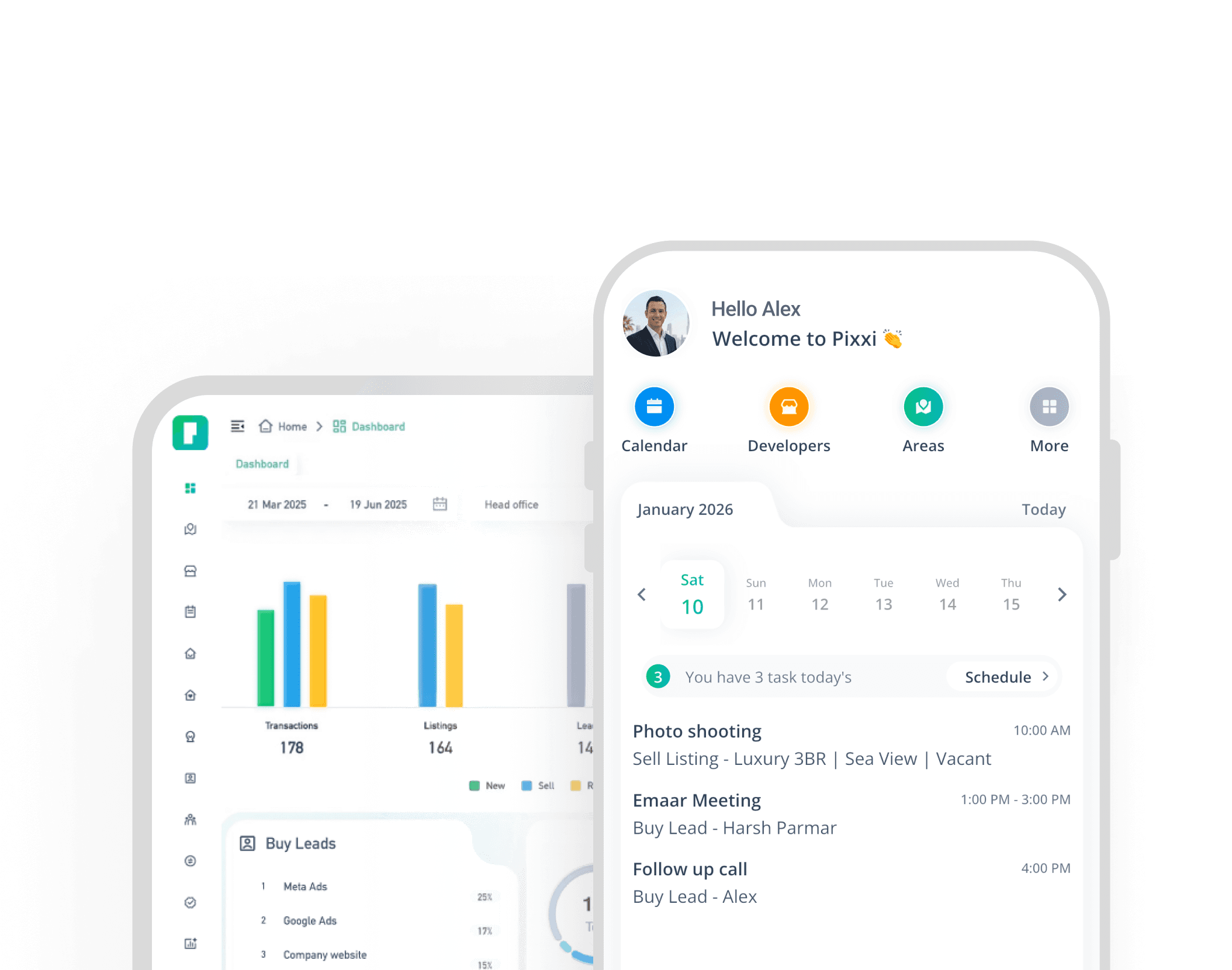
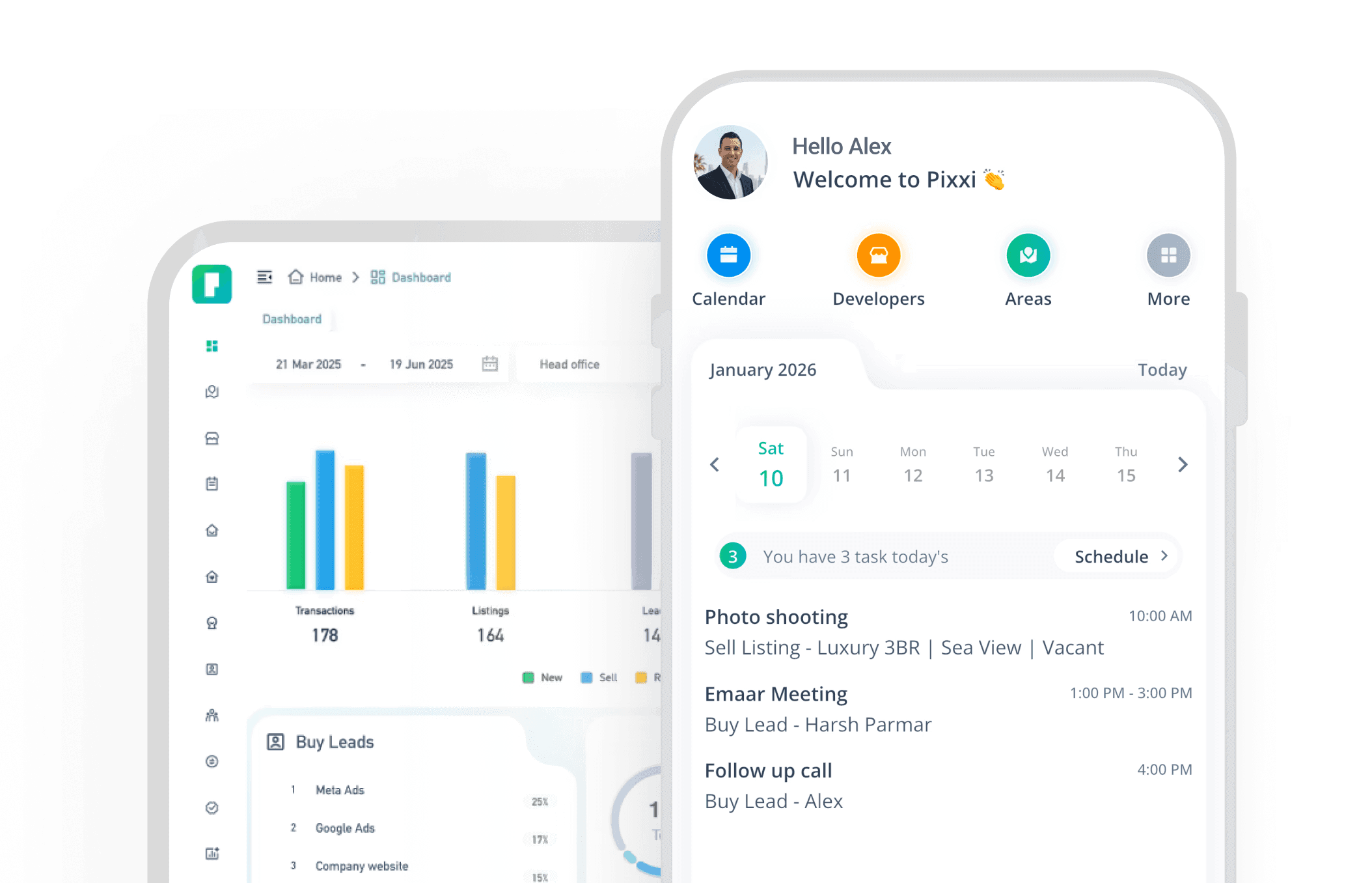
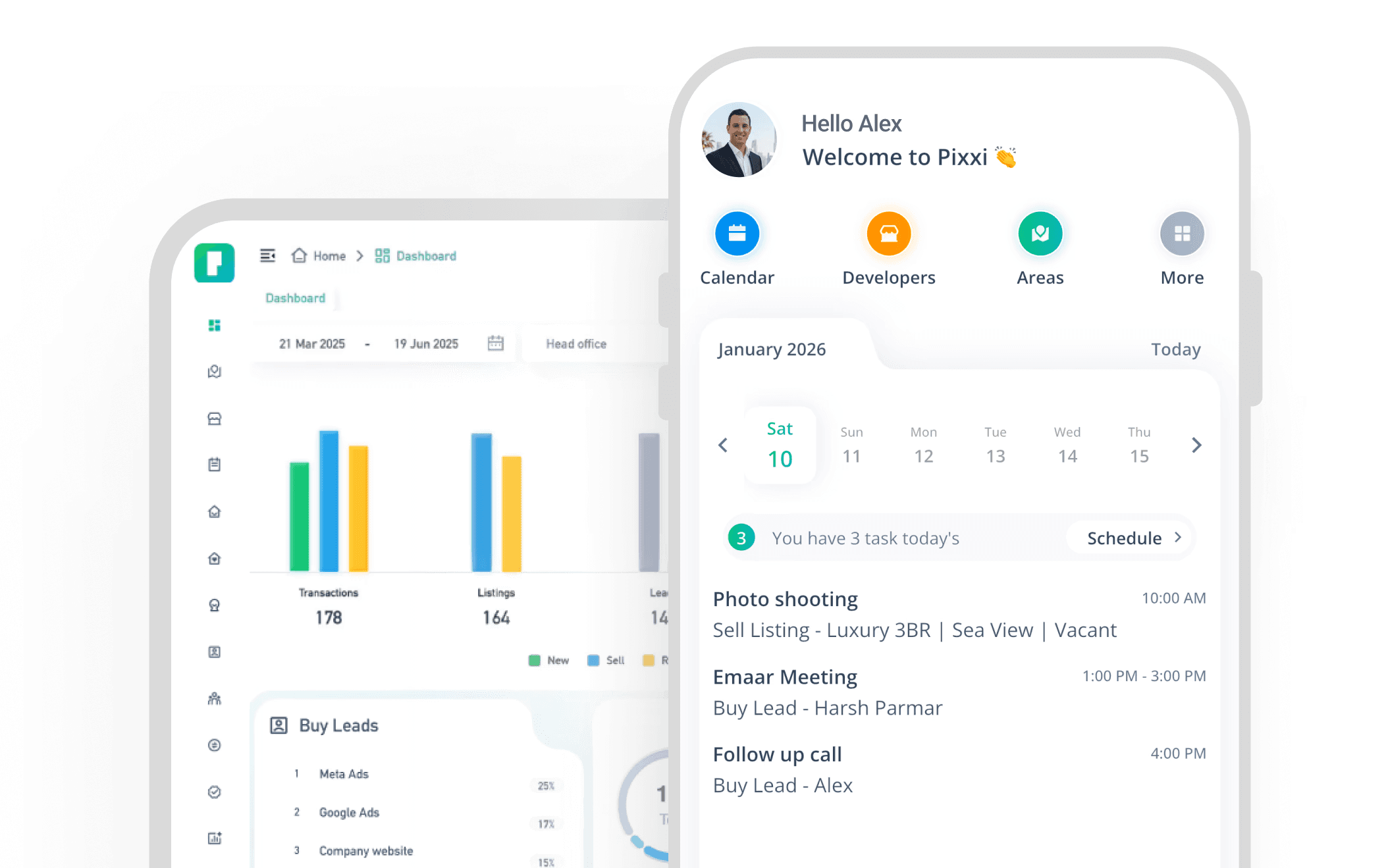
Agents can also access their work through the Pixxi mobile app, keeping them connected while they are away from their desks.
Growth Needs Structure
Excel can be an excellent spreadsheet.
WhatsApp can be an excellent communication tool.
Neither needs to disappear.
But as a real estate company grows, the systems behind the business need to grow with it.
Because adding more agents, more leads and more listings to fragmented processes does not create scalability.
It creates more fragmentation.
The goal isn't to use fewer tools. It's to build one structured operation behind them.
Your Brokerage Has Outgrown the Spreadsheet. What's Next?
Bring your leads, agents, listings, deals, commissions and performance together with Pixxi CRM the operating system behind your brokerage.
Experience the fastest, most complete real estate CRM on mobile
With Pixxi, your entire business travels with you real-time updates, instant lead access, and seamless team communication.