Implementing a CRM does not automatically make a real estate brokerage more organized.
A company can invest in new software, migrate thousands of contacts, train its agents and still find the team using spreadsheets, WhatsApp, personal phones and manual processes months later.
The problem is often not simply the CRM itself.
CRM implementations can struggle when the technology, brokerage workflow and people using the system are not properly aligned.
For Dubai real estate companies, this is particularly important because the CRM may need to support property portals, high lead volumes, listings, off-plan projects, transactions, commissions and multiple agent teams.
So why do CRM implementations struggle and what should brokerages do differently?
1. The CRM Doesn't Match the Brokerage's Actual Workflow
One of the biggest mistakes is selecting a CRM before mapping how the brokerage operates.
Consider a typical inquiry:
Lead received → Agent assigned → Contact attempted → Requirement qualified → Property matched → Viewing arranged → Negotiation → Transaction → Commission
Now add the realities of a UAE brokerage:
Property portal inquiries
Website leads
Advertising campaigns
Sales and rental teams
Secondary and off-plan teams
Owners and buyers
Internal approvals
Referral brokers
Commission splits
If the CRM cannot support these processes naturally, employees begin creating workarounds.
And once the workaround becomes easier than using the CRM, adoption starts declining.
What to do instead
Before selecting or configuring a CRM, map your most important workflows from beginning to end.
Then ask the CRM provider to demonstrate those exact processes.
Don't only ask:
“Do you have lead management?”
Ask:
“Show me what happens from the moment a Property Finder inquiry arrives until the agent contacts the client.”
Real workflows reveal much more than feature lists.
2. Leads Enter the Business From Too Many Places
Dubai brokerages can receive inquiries from several channels simultaneously.
These may include property portals, company websites, advertising campaigns, referrals, databases and direct inquiries.
When those leads are handled through separate systems, management can lose visibility.
A lead may exist in one portal dashboard.
Another may be assigned manually.
Another may remain in someone's WhatsApp.
Another may be sitting in a spreadsheet.
The issue is not simply where the lead originates.
The issue is whether every inquiry ultimately enters a controlled process.
What to do instead
Create one central lead-management environment.
Management should be able to understand:
Where the lead originated
When it arrived
Who received it
Whether it was contacted
What actions were completed
What the client requires
What the next action is
Whether the opportunity progressed
The objective is simple:
Every lead should have an owner, a status and a next action.
3. Lead Distribution Is Manual or Unstructured
As a brokerage grows, manually distributing every inquiry becomes increasingly difficult.
Managers may start assigning leads through messages or based on whoever appears available.
This creates several problems.
Distribution can become inconsistent.
Agents may receive more leads than they can properly handle.
And management may have limited visibility over inquiries that aren't being actioned.
What to do instead
Establish clear lead-distribution rules.
Depending on the brokerage, distribution could consider:
Team
Lead source
Agent availability
Working hours
Language
Property specialization
Rotation rules
The CRM should then help enforce the agreed process.
Equally important is what happens after assignment.
If an agent does not take the required action, the brokerage needs visibility and a defined escalation process.
4. The CRM Becomes a Management Tool Instead of an Agent Tool
Management may want dashboards, reports and control.
Agents want something very different:
Speed.
They want to receive a lead, see the client's information, make contact, schedule the next action and move on.
If updating the CRM requires too many steps, agents may postpone updates until later or stop doing them entirely.
Then management sees incomplete information and assumes the CRM is the problem.
What to do instead
When evaluating a CRM, test the agent experience.
Ask an agent to perform everyday tasks:
Open a new lead
Call the client
Update the status
Add a note
Schedule a follow-up
Find a property
Arrange a viewing
Count the steps.
A CRM should make the correct process easier, not harder.
5. The Brokerage Has No Defined CRM Rules
Software cannot create operational discipline by itself.
Consider something as simple as lead statuses.
One agent may mark a lead as:
Not Interested
Another may use:
Lost
Another may leave the lead untouched.
Another may keep every lead marked:
In Progress
The CRM now contains data but that data is inconsistent.
What to do instead
Create clear CRM operating standards.
For example:
New inquiry received but not yet actioned.
Contacted first successful contact completed.
Qualified requirements confirmed.
Viewing viewing arranged or completed.
Negotiation active commercial discussion.
Won transaction completed.
Lost opportunity closed with a recorded reason.
The exact stages should reflect your company's process.
What's important is that everyone understands what they mean.
6. Management Tracks Activity Instead of Outcomes
A dashboard showing:
500 calls
may look impressive.
But it doesn't necessarily tell management whether the business is performing well.
The better questions are:
How many leads were contacted?
How quickly?
How many were qualified?
How many resulted in viewings?
How many progressed to transactions?
Which sources generated those transactions?
Which teams convert effectively?
A useful CRM should connect activity with outcomes.
What to do instead
Build reporting around the customer journey:
Lead → Contact → Qualification → Viewing → Transaction
Then analyze performance by:
Agent
Team
Lead source
Time period
Property segment
This gives management a much clearer understanding of where opportunities are being lost.
7. Listings Are Managed Separately From Leads
A real estate CRM becomes much more useful when client requirements and property inventory exist within the same environment.
If leads are in one system while listings are stored elsewhere, agents constantly move between platforms.
That also makes matching demand with available inventory more difficult.
What to do instead
Connect leads and property inventory.
An agent working with a qualified buyer should be able to identify suitable inventory without rebuilding the client's requirements somewhere else.
Similarly, management should have centralized visibility over listings and their status.
8. Transactions Leave the CRM
Another common operational gap occurs after the client decides to proceed.
The lead may have been managed perfectly inside the CRM, but the actual transaction moves into emails, spreadsheets and separate documents.
Management then loses the connection between:
Lead source → Agent → Listing → Transaction → Commission
What to do instead
Where possible, keep the transaction connected to the original CRM journey.
This creates better operational visibility and makes it easier to understand which activities and sources ultimately generate revenue.
9. Commission Tracking Remains Manual
Commission management can become increasingly complicated as teams grow.
A transaction may involve:
Listing agent
Closing agent
Team leader
External broker
Referral partner
If the CRM tracks the transaction but commissions remain in separate spreadsheets, part of the operational picture is still fragmented.
What to do instead
Define commission structures and approval processes as part of the CRM implementation.
The system should support the level of visibility and control required by management and finance.
10. Training Happens Once
A CRM launch often follows this pattern:
Training day → Team starts using CRM → New employees join → Processes change → Usage becomes inconsistent.
CRM adoption is not a one-day project.
What to do instead
Create an ongoing adoption process.
New agents should receive structured onboarding.
Existing agents should receive refreshers.
Managers should regularly review usage and identify where teams are struggling.
And when the company changes its process, the CRM workflow should be reviewed too.
11. The Brokerage Tries to Digitize a Broken Process
This may be the most important point.
If a company has no clear rules for lead distribution, follow-up, listings, approvals or transactions, implementing software will not automatically solve the problem.
It may simply digitize the confusion.
Before automating a workflow, define it.
Process first. Technology second. Automation third.
How to Tell If Your CRM Is Actually Working
A successful CRM implementation should create measurable operational improvement.
Ask these questions:
Lead visibility:
Can management account for every new inquiry?
Agent accountability:
Can managers see whether leads are being actioned?
Adoption:
Are agents actually using the system during their normal workday?
Data quality:
Can management trust the information inside the CRM?
Inventory visibility:
Are listings centralized and accessible?
Transaction visibility:
Can management follow opportunities through to completed deals?
Performance visibility:
Can managers understand conversion not just activity?
If the answer to several of these questions is no, the brokerage may need to review either its CRM configuration, internal processes, team adoption or the platform itself.
What to Look for in a Real Estate CRM in Dubai
When evaluating a CRM, look beyond the feature count.
Consider whether it can support:
UAE real estate workflows
Property portal lead capture
Automated lead distribution
Follow-up management
Listings and inventory
Off-plan projects
Transactions
Commission structures
Permissions
Approval workflows
Agent and team KPIs
Management reporting
Mobile usage
Database management
Most importantly, ask the provider to demonstrate your actual workflow.
How Pixxi Approaches Brokerage Operations
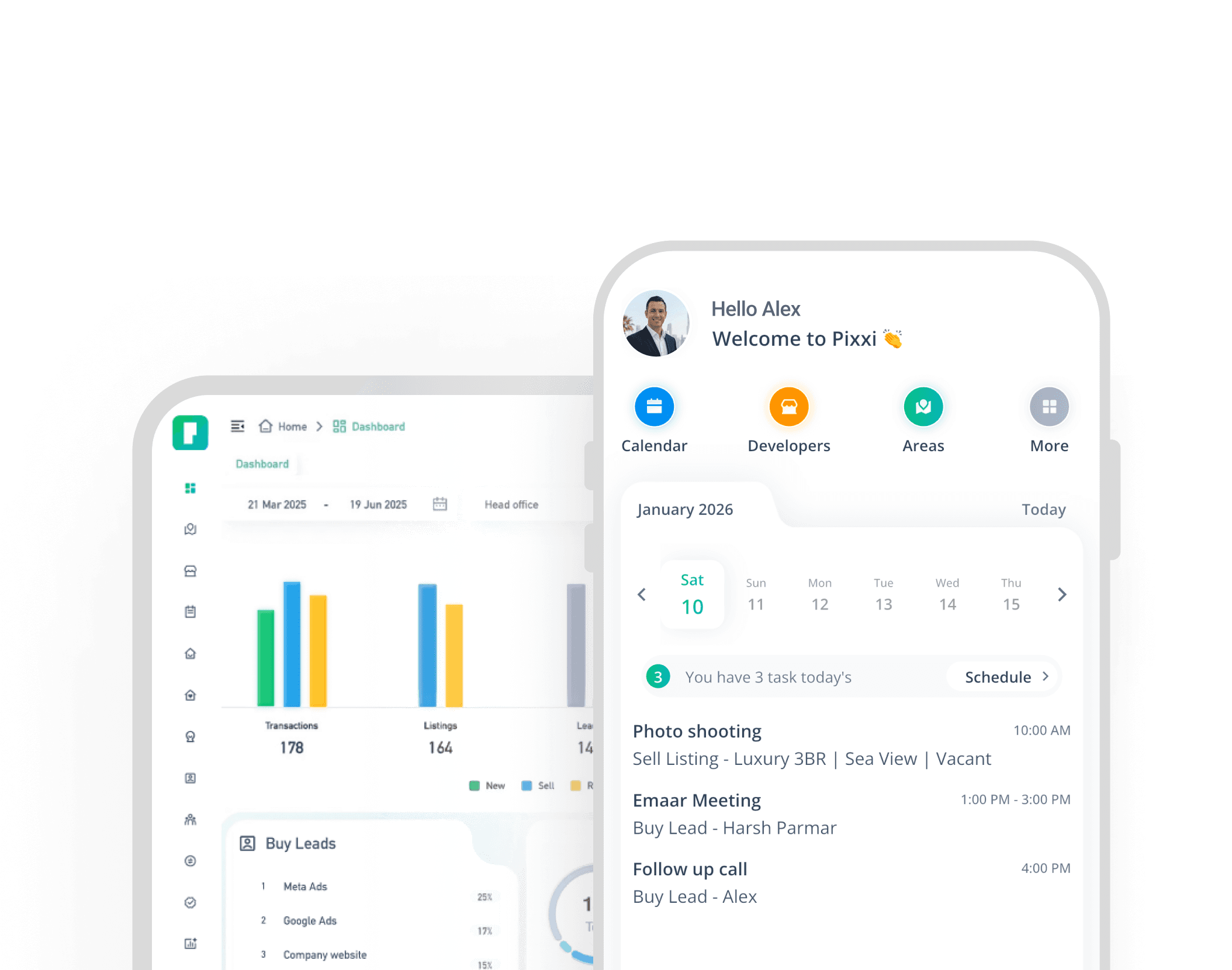
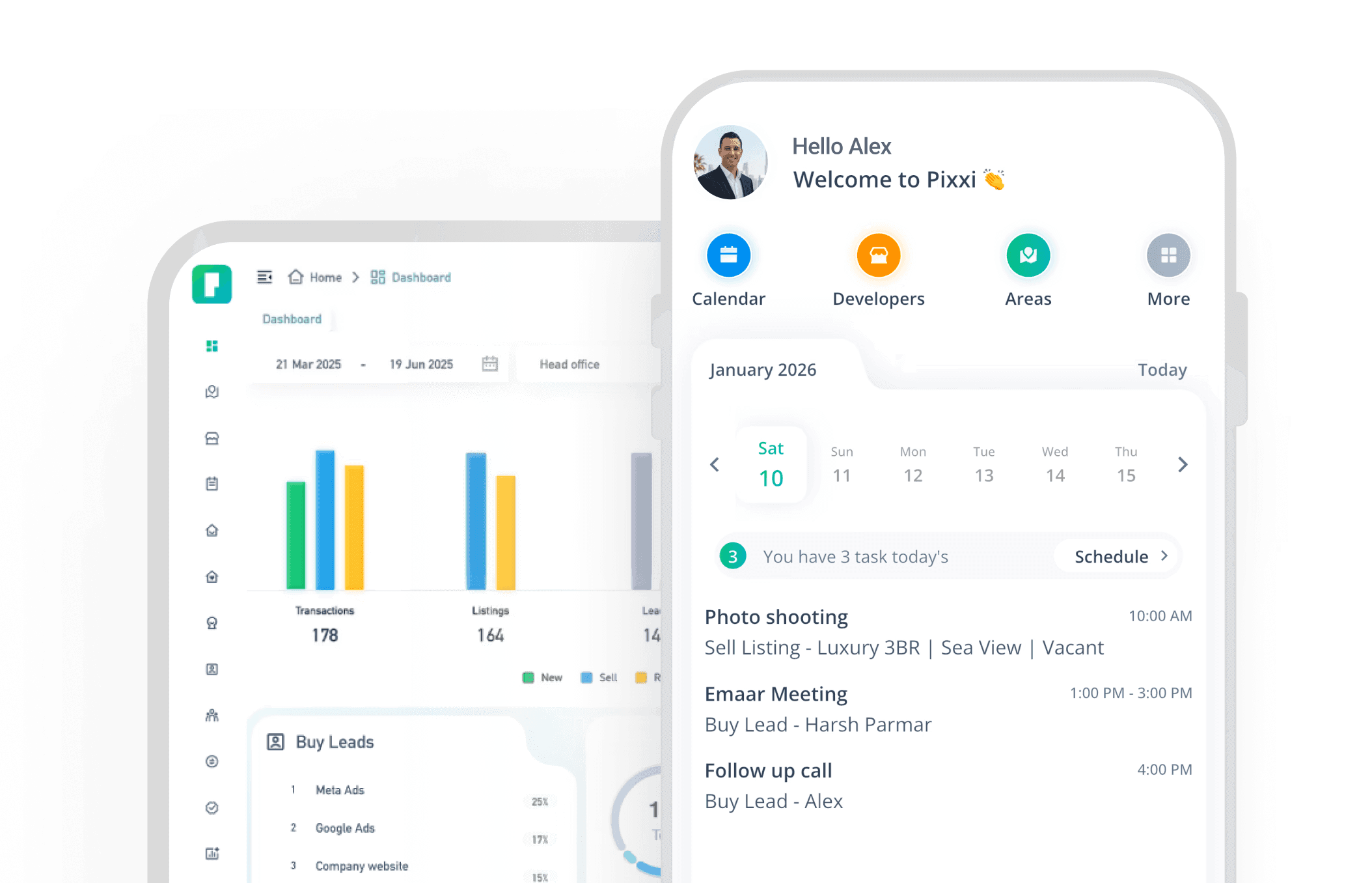
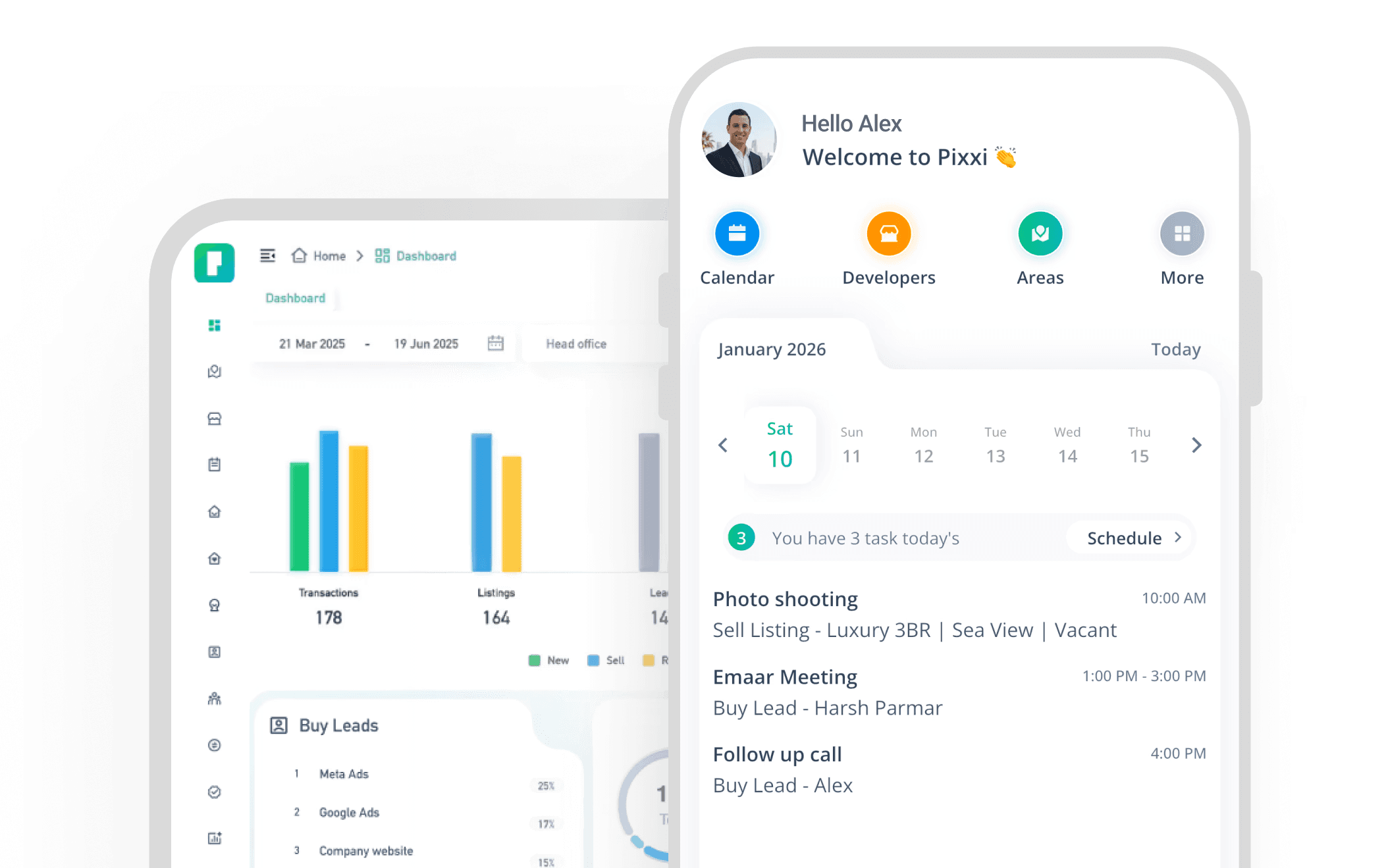
Pixxi CRM is built specifically around UAE real estate brokerage operations.
The platform connects lead management, lead rotation, listings, owners, off-plan projects, transactions, commissions, workflows, approvals, database management and KPI reporting within one environment.
For brokerages, the objective is not simply to store more information.
It is to create a structured journey from:
Inquiry → Agent → Follow-up → Property → Viewing → Transaction → Commission
That gives agents a clearer process to follow while providing management with greater visibility over what is happening across the business.
Before You Replace Your CRM, Ask This
If your current CRM isn't delivering the results you expected, don't immediately assume you need different software.
First determine why it isn't working.
Is the problem:
The technology?
The configuration?
The workflow?
The data?
The training?
The team's adoption?
Or a combination of them?
Sometimes the platform needs to change.
Sometimes the process needs to change.
And sometimes the company needs to rethink how the two work together.
The purpose of a CRM isn't simply to digitize a brokerage.
It's to create a more structured, measurable and scalable way of operating.
Is Your Current CRM Working for Your Brokerage?
If your team is still relying heavily on spreadsheets, manual lead distribution or disconnected systems, a CRM health check can help identify where the gaps are.
Book a Pixxi demo to see how your existing brokerage workflow can be structured inside a UAE-focused real estate CRM.
Experience the fastest, most complete real estate CRM on mobile
With Pixxi, your entire business travels with you real-time updates, instant lead access, and seamless team communication.